AI Workflow Specialist: turn repeat work into workflows you can trust
A free course in ten short lessons, with no code: find the jobs worth automating, build the workflow with a person where it matters, then test it and measure what it saves.
Regular price USD 49.99. Your first certification is free. Free with any paid Sophyx plan. Certificates take up to 30% off your plan. See plans
short video lessons
10
minutes of video
30
questions in the final exam
40
months the certificate is valid
12
Three modules, one workflow
Every lesson follows Priya at Tidewell Cycles as she turns the shop's repair enquiries into a workflow she can trust.
Priya's week, in minutes
Repair enquiries175
Rental bookings90
Review replies48
Weekly social post40
Deposit refunds30
Parts orders30
Repair enquiries: 25 × 7 = 175 min a week
Module 1
Find the work worth automating
Log a normal week and price each repeat job in minutes. Map the one that costs most, step by step, with its unwritten rules written down, then score it for worth and risk.
TriggerA message on the website form
AIReads it into the repair card
RuleSafety flag? Straight to Owen
PersonPriya approves the reply
Module 2
Build the workflow
A reusable assistant with standing instructions, a template with named fields, and a chain of small steps: rules for the clear decisions, AI for reading and writing, and a person where work leaves the building.
20 real past casesPass bar: 18
Run 1
0 of 20
Module 3
Run it well
Test it on real past cases against answers you wrote first. Make failures loud, keep a way back to doing it by hand, and measure before and after the same way.
Score it before you build
Not every repeat job should become a workflow. Each one gets a worth score, the hours it saves a month after building and looking after it, and a risk score, what a mistake costs and how easily it slips through. The board then says what to do with it.
Automate the jobs high in worth and low in risk
Where mistakes cost, automate the draft and have a person approve it
Keep a never list of decisions that stay with a person, however well they score
Worth and risk · Priya's six jobsLesson 3
Risk →
Leave it alone
Low worth, high risk
Parts ordersabout 1 h a month
Draft and approve
High worth, real risk
Repair repliesabout 8 h a monthPriya approves
Keep a saved prompt
Low worth, low risk
Review repliesabout 2 h a month
Weekly social postunder 1 h a month
Automate
High worth, low risk
Rental confirmationsabout 4 h a month
Deposit refundsabout 1 h a monthNever list: a person decides
Worth →
Priya's six jobs, as she places them in lesson 3.
Put a person where work leaves the building
An approval only protects you if you decide what happens when someone says no, or says nothing. In the course you set both and test them before anything reaches a customer.
Approve sends; decline brings the draft back to your list
No answer becomes a reminder, never a send
Anything about safety goes straight to a named person
Approval · repair replyExample
Dan: “My gears keep slipping. Could you fit me in this week?”
Draft reply
Hi Dan, we can do a gear tune-up on Thursday at 10. It costs £45.
£45, from the price list
ApproveEditDecline
ApproveThe reply goes to DanTested
DeclineBack to Priya's list, never sentTested
No answer in 4 hA reminder to Priya, never a sendTested
Brakes or anything about safety: the whole card goes to Owen before any reply.
Priya's approval step, from lesson 7.
Test it, watch it, measure it
Before a workflow runs on real work, it passes a test set of real past cases. Once it runs, every error reaches a named person. Then numbers measured the same way before and after decide whether it stays.
15 to 20 real past cases, with the right answers written down first
Errors to a named person and a deputy, and a way back to doing it by hand
Checking, upkeep and cost counted in the time you save
Repair enquiries · before and afterSame two weeks
Before25 × 7 min = 175 min a week
After25 × 2 min + 30 upkeep = 80 min
About 95 min a week saved
Her guess was 3 hours a week
Tools: about £25 a month
The decisionKeepImproveRetire
Priya's numbers from lesson 10.
The syllabus
3 modules, 10 lessons, about 30 minutes of video. Each lesson has captions, chapters, a transcript and a practice quiz.
Before you start
AI Fundamentals (AX-100) first is recommended, not required. No code and no technical background are needed. The course is not legal advice, and finishing it does not make anyone compliant with any law.
Worked example
The lessons follow Priya, the operations and marketing lead at Tidewell Cycles, a fictional seaside bike shop with repairs and rentals. The assistants and automation tools on screen are generic ones. Every brand in the course is fictional and every number is illustrative.
1
Module 1 · 3 lessons ·
Find the Work Worth Automating
Spotting the repeat work in a normal week and pricing it in minutes a week; mapping a job as it is done today, with each step’s input, decision, output and checker and the unwritten rules written down; scoring each job for worth and risk, with the never list of decisions that stay with a person.
Repeat work hides in plain sight: people remember the jobs they dislike, not the ones they repeat. Log a normal week, with every repeat job, how many times it came and how many minutes it took. Good candidates for an AI workflow come often, go much the same way each time, are mostly reading and writing, and follow rules someone can explain. Times a week multiplied by the minutes each time shows what a job costs, and the log becomes the baseline for measuring later. Worked example: Priya finds that repair enquiries cost nearly three hours a week, far more than the social post she dreads.
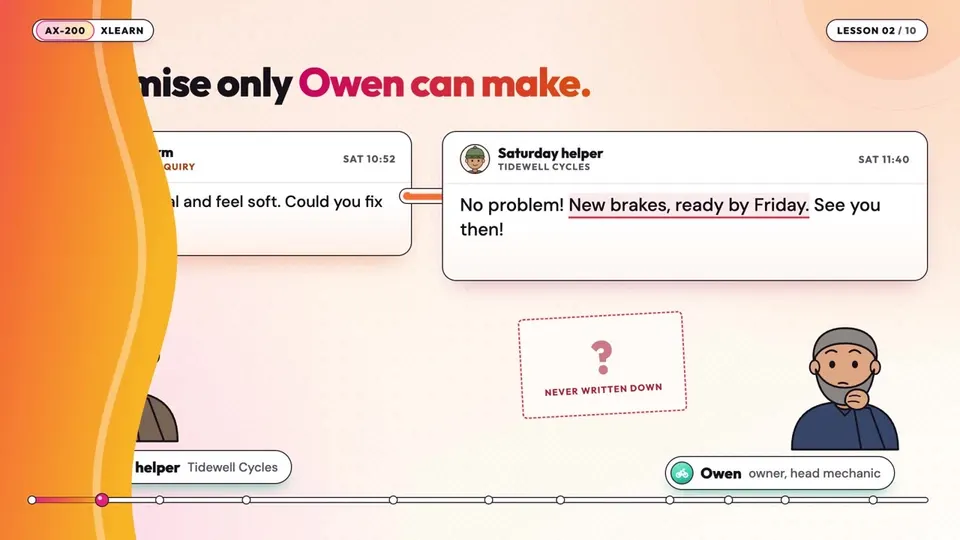
Before any AI touches a job, map it as it is done today: each step’s input, the decision in it, its output and who checks it. Mistakes and judgement live at the decision points. Experts carry unwritten rules, and a step whose decision nobody can describe is not ready for AI. An assistant can help turn notes into a map and list the decisions the notes don’t explain. Worked example: the Saturday helper promised new brakes by Friday, because nobody had written down that brakes are always the head mechanic’s call.
Score each candidate for worth (the hours saved a month, after the time to build and look after it) and for risk (what a mistake costs and how easily it slips through). High worth and low risk: automate. High worth and real risk: automate the draft and have a person approve. Low worth: keep a saved prompt or leave it alone. Decisions about people, money a customer may dispute and anything about safety stay with a person whatever the score; check your local rules. When the words never change, a fixed template beats AI. Worked example: Priya’s six jobs, including the damage-deposit refunds the assistant called “well suited”, which she keeps with a person.
2
Module 2 · 4 lessons ·
Build the Workflow
A reusable assistant (standing instructions in four parts plus current, dated knowledge files with owners); templates with named fields, allowed values and a rule for gaps; chaining a trigger and small steps, with rules for clear decisions and AI for reading and writing; approvals, tested declines and no-answers, and hand-offs with everything the next person needs.
A reusable (custom) assistant is standing instructions plus knowledge files. The instructions are the four-part prompt (task, context, facts, format) written once, with what to do when the answer is missing. Knowledge files are searched for passages that fit, not memorised, so an old copy competes with the current one: keep one current fact in one place, date every file and give it an owner. The assistant does not learn from chats; it changes only when its instructions or files change. Worked example: Tidewell’s workshop desk assistant quotes last year’s price until the old price list is removed.
Give every output the same shape: named fields in a fixed order, allowed values for fields with set answers, and a rule for gaps (“not given”, never a guess), so the next step and the next person can use it. Some tools can force the shape, but nothing forces the values to be true, so check the values that decide where the work goes. Worked example: free-form drafts become an enquiry card, and a kerb crash comes back as a perfect card with the wrong safety flag.
A workflow is a trigger, a chain of small steps that each do one job, and an output that lands where people work. Rules make the decisions that have a clear test (a safety flag routes a job to the mechanic); AI reads messy messages and writes drafts; a plain word rule can back up a costly decision. Start with the smallest chain that works and test each step on real examples before joining them, so a failure points to one step. Worked example: one giant prompt priced a brake failure as a tune-up; the chain routes it to the head mechanic.
Put a person where work leaves the building or can’t be undone: replies to customers, bookings, refunds. An approval step only passes a decision on, so set what decline and no answer do, and test both: declined drafts go back to a person, and silence brings a reminder, never a send. Hand work on with everything the next person needs, and keep approvals short, with the risky parts first, so they stay real checks. Worked example: Priya’s declined draft went out anyway until a rule after the approval acted on her decision.
3
Module 3 · 3 lessons ·
Run It Well
Testing on real past cases, edge cases included, against answers written first, with a yes-or-no checklist and a pass bar, re-run after every change; loud failures, fallbacks, least access and treating outside text as information; measuring before and after the same way, net of checking, upkeep and cost, and deciding to keep, improve or retire.
Before a workflow runs on real work, test it on 15 to 20 real past cases with personal details replaced, edge cases included (vague, angry, urgent, off-topic). Write the right result for each case before running it, score outputs with a short yes-or-no checklist, and set a pass bar in which some checks must pass every time. Change one thing at a time and run the whole set again after any change to the instructions, the files or the tool. Worked example: 16 of 20 on the first run, with a missed spongy-brake flag; 19 of 20, every safety case right, after three changes.
Workflows break, often silently. Send every error to a named person and a deputy, keep a fallback that hands the job back to people, and look at the run history every week. Give the workflow only the access its steps need, keep customer data in approved tools, and treat what customers write as information, never as orders: a message can contain text that tries to steer the AI, so nothing costly should happen without a person. Worked example: a renamed form field stopped Tidewell’s workflow for two days while the error emails went to an inbox nobody reads.
Measure a workflow before and after in the same way and over the same period: minutes per item including checking, upkeep, turnaround, mistakes caught and cost. People misjudge the time a tool saves: in a 2025 study, experienced developers were slower with AI tools yet believed they had been faster. Improve one change at a time and re-run the tests; write a retire rule in advance and switch the workflow off when it no longer pays. Worked example: Priya guessed three hours a week; the measured saving was about 95 minutes, and replies went out the same morning instead of the next day.
Watch, practise, prove it, then get certified: the same four steps in every Xlearn by Sophyx course.
1
Watch
Watch all 10 lessons. Each one is about 2 to 3 minutes, with captions, chapters and a transcript.
2
Practice
Take the practice quiz after each lesson. Try as often as you like, and every wrong answer tells you why.
3
Prove
Pass the final exam: 40 scenario questions about different kinds of businesses, 60 minutes, 75% to pass, and 24 hours between attempts. Pass it and the certificate is yours.
4
Get certified
Your certificate gets its own credential ID and a public page anyone can check. Add it to LinkedIn in one click or download the PDF. It is valid for 12 months.
Final exam
Scenario questions about different kinds of businesses. You can retake it after 24 hours.
questions
40
minutes
60
to pass
75%
Your certificate
One page that proves what you learned, with a link anyone can open to check it.
Xlearn by Sophyx
Certificate of completion
Sample
This certifies that
Your name
has earned the credential
Sophyx Certified AI Workflow Specialist – Associate
for completing the 10 lessons of AI Workflow Specialist and passing the final exam.
Code
AX-200 · Associate
Valid
12 months
Credential ID
AX-200-26-8D4R6TMV
Verify at
sophyx.io/verify/AX-200-26-8D4R6TMV
Verified
Sample certificate. Yours carries your name and its own credential ID.
A unique, random credential ID
A public verification page anyone can open
One-click Add to LinkedIn
A PDF you can download and share
Valid for 12 months
It is a Sophyx credential, not an accredited qualification.
The discount lasts while your certificates are valid. A new certificate never lowers the discount you have. It applies to Pro, Agency Lite and Agency Pro.
AI Workflow Specialist (AX-200) is a free 10-lesson video course by Sophyx for people at work who want to turn the jobs they repeat into reliable AI workflows, with no code. It teaches you to find the work worth automating, build the workflow with templates and approvals, then test it, plan for failures and measure what it saves. It ends with the Sophyx Certified AI Workflow Specialist – Associate certificate.
Who is it for?
Operations, marketing and admin people, founders and small-business owners: anyone with jobs that come in often and go much the same way each time. You build in no-code tools, so no programming is needed.
Do I need to take AI Fundamentals first?
It is recommended, not required. If you already prompt well and check what an assistant gives you, you can start here. No code is needed.
What does it cover?
Three modules. Find the work worth automating: log a week of repeat work and price it in minutes, map each job step by step with the unwritten rules written down, and score each job for worth and risk, with a list of decisions that always stay with a person. Build the workflow: a reusable assistant with standing instructions and current knowledge files, templates with named fields and a rule for gaps, a chain of small steps where rules make the clear decisions, and approvals whose decline and no-answer paths are tested. Run it well: test on real past cases against answers written first, make failures loud with a fallback and only the access each step needs, and measure before and after the same way.
Does it teach a particular tool?
No. The assistants and automation tools on screen are generic, so the method works in whichever approved tools your organisation uses. Feature and setting details are as of October 2026 and change. The course is not legal advice.
What is the worked example?
Priya, the operations and marketing lead at Tidewell Cycles, a fictional seaside bike shop with repairs and rentals. Repair enquiries take her about 175 minutes a week, so she builds a workflow for them: the AI reads each message and drafts a reply from a template, a rule sends anything about safety straight to Owen, the owner, and Priya approves every reply before it goes out. All brands and people in the course are fictional and all numbers are illustrative.
How long does it take?
There are 10 lessons in three modules and about 30 minutes of video, each lesson with a practice quiz you can retry as often as you like. Then comes the final exam.
What is the final exam like?
The final exam has 40 questions, most of them scenarios from different kinds of businesses, a 60-minute limit and a 75% pass mark, with 24 hours between attempts.
Is the certificate an accredited qualification?
No. It is a Sophyx credential, not an accredited qualification, and it does not come from a university or a government body. It shows that you watched the course, took the practice quizzes and passed the final exam. Anyone can check it on its public verification page, and it is valid for 12 months.
Is it free?
Your first certification is free. Free with any paid Sophyx plan. The regular price of AI Workflow Specialist is USD 49.99.
More in AI Experience
The AI Experience courses build on each other, from your first prompt to an agent of your own. See the courses coming next.