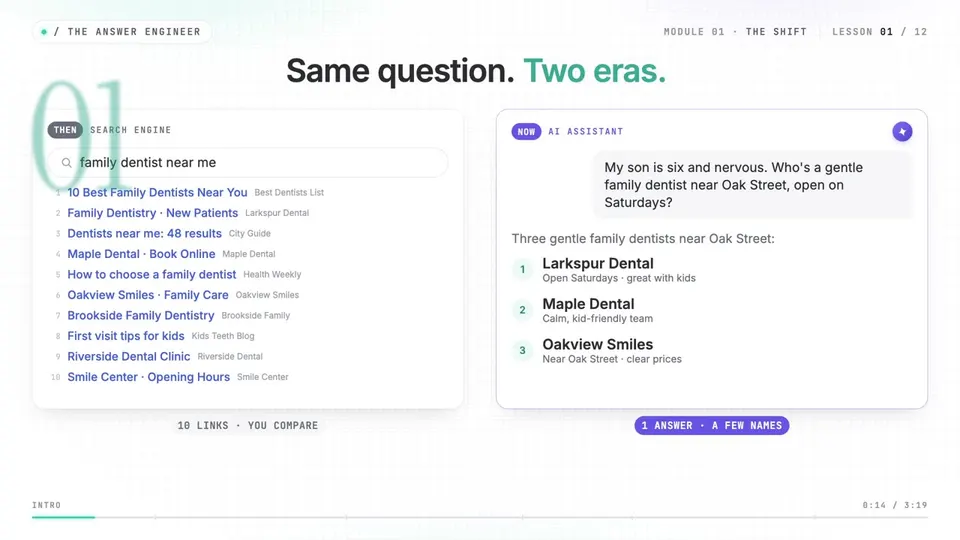
Flagship · AE-200
The Answer Engineer
Earns: Certified Answer Engineer
How AI answers are made, and how to get a brand named in them. The core course, and the place to start.
- 12 lessons
- 29 min of video
- Free
Associate course · AEO-210
Earn the Sophyx Certified AEO Content Specialist – Associate credential.
AEO Content Specialist is a free 12-lesson video course by Sophyx for content teams. You learn to plan, write, prove, refresh and measure content that AI assistants quote and send buyers to. It builds on The Answer Engineer, and every lesson works through one fictional company: Juniper Tours, a food and walking tour business in Lisbon and Porto.
Lesson 1 of 12 · AEO Content Specialist
How AI reads your content
Captions, 2:20
Sophyx Certified AEO Content Specialist – Associate
Verifiable · valid 12 months
You plan what gets written. You want to turn the questions buyers ask into a content map, with the right page for each one.
You write the pages. You want answer-first pages and sections an assistant can lift out and quote on their own.
You own the results. You want to keep pages fresh, place them where AI looks, and judge them by the visits they bring.
The Answer Engineer (AE-200) first is recommended. If you already know how AI search works, you can start here.
The lessons follow Juniper Tours, a fictional food and walking tour company in Lisbon and Porto. Every brand in the course is fictional and every number is illustrative.
A sample of the 36 objectives across the 4 modules.
Twelve lessons in four modules: plan for the answer, write answer-ready pages, prove it, then refresh, distribute and measure.
4 modules, 12 lessons, about 27 minutes of video. Each lesson has captions, chapters, a transcript and a practice quiz.
Module 1 · 3 lessons ·
How AI uses content, and how to turn a prompt set into a content map and the right page types.
Lesson 1
Retrieval systems split pages into passages, score each one against the question and quote the best few. Headings set the passage boundaries; a passage that names its subject and answers plainly is easy to retrieve and quote. Content locked in images, scripts or PDFs is often skipped.
Lesson 2
Group the prompt set into clusters that share one underlying need, give each cluster one page that answers it best, and use AI answers to find gaps: prompts where assistants cite others and no page of yours answers.
Lesson 3
Each intent is best served by a page type: guides and lists for discover prompts, comparison and alternatives pages for compare prompts, pricing, specs and how-to pages for decide prompts, and hub pages that connect a topic. Match the page to the question.
Module 2 · 3 lessons ·
The answer-first page, passage engineering, and honest comparisons.
Lesson 4
An answer-first page puts the question in the heading, a short direct answer in the first one or two sentences, a key-facts box with plain facts, then details, proof and next steps. It follows the inverted pyramid: conclusion first, support after.
Lesson 5
Engineer each section to stand alone: one idea per section, the subject named, specifics included, no references like "as mentioned above". Use lists for steps and tables for comparisons so structure carries meaning.
Lesson 6
Comparison and alternatives pages answer compare prompts. Use clear criteria, accurate and dated facts about every option, sources, and honest "best for" verdicts, including when a competitor fits better. Disclose that you wrote it.
Module 3 · 3 lessons ·
Evidence, authors and expertise, and making video, audio, images and PDFs readable.
Lesson 7
Strong content proves its claims: sourced facts, original data such as surveys or tests, quotes, and "as of" dates on numbers. Replace superlatives with evidence and link to sources so readers and AI can check.
Lesson 8
Put a real, qualified person behind every answer: bylines with role and experience, author pages linked to their profiles, first-hand detail only an expert would know, and an expert reviewer for advice content.
Lesson 9
Make non-text content readable: transcripts and summaries for video and audio, descriptive alt text for images, HTML versions of PDFs and slide decks. If key facts only live in media, AI may never see them.
Module 4 · 3 lessons ·
Freshness workflows, distribution to the sources AI cites, and measuring content by what it earns.
Lesson 10
Keep a content inventory with owners, purpose, last update and next review. Watch for decay: falling AI citations or visits, or facts that changed. Refresh real content first, then the date, and log what changed.
Lesson 11
Distribute where AI already looks: the sources assistants cite for your prompts. Repurpose content into guest articles, partner pages, community answers and social posts, disclose your affiliation, and keep the core facts identical everywhere.
Lesson 12
Score each page by what it earns: AI crawler reads, mentions and citations for its prompts, which passage gets quoted, AI referral visits and conversions. Use the scorecard to fix pages that are seen but not visited, and expand around pages that win.
Watch, practice, prove, then get certified: the same four steps in every Xlearn by Sophyx course.
Watch all 12 lessons. Each one is about 2 to 3 minutes, with captions, chapters and a transcript.
Take the practice quiz after each lesson. Try as often as you like, and every wrong answer tells you why.
Pass the final exam: 30 scenario questions about different kinds of businesses, 45 minutes, 80% to pass, and 24 hours between attempts. Then a final project, scored against a written rubric with feedback. You can revise and resubmit.
Your certificate gets its own credential ID and a public page anyone can check. Add it to LinkedIn in one click or download the PDF. It is valid for 12 months.
Scenario questions about different kinds of businesses. You can retake it after 24 hours.
Pick a brand: your own, a client's with their permission, or the fictional Juniper Tours pack. Hand in one deliverable for each part below. Each part is graded pass or fail against a written rubric, and every part must pass. You get written feedback and can revise and resubmit.
Content map
20 or more prompts clustered by need and intent, each cluster mapped to a page type and a page, with 3 gaps marked.
Three answer-ready pages
One answer-first page, one fair comparison page and one FAQ or how-to page, written or rewritten in full.
Proof layer
Sourced and dated evidence, at least one original data point, bylines and an author page, and text versions of any key media.
Refresh and distribution plan
An inventory with owners and review dates, and 3 cited sources to contribute to, with one contribution drafted.
Content scorecard
Baseline crawler reads, citations, AI visits and conversions for the pages, and the rule for what to write next.
One page that proves what you learned, with a link anyone can open to check it.

Xlearn by Sophyx
Certificate of completion
This certifies that
Your name
has earned the credential
Sophyx Certified AEO Content Specialist – Associate
for completing the 12 lessons of AEO Content Specialist, passing the final exam and passing the final project.
It is a Sophyx credential, not an accredited qualification.
Open a sample certificateMore on how certificates work is on the Xlearn by Sophyx page.
Every course sits on one ladder, from fundamentals to expert. See the courses coming next.
Flagship · AE-200
Earns: Certified Answer Engineer
How AI answers are made, and how to get a brand named in them. The core course, and the place to start.
Professional · GEO-300
Earns: Sophyx Certified Technical GEO Engineer – Professional
For developers and technical SEOs: build a site AI can fetch, read and act on, and keep it that way.
Professional · GEO-310
Earns: Sophyx Certified GEO Analytics Professional
For analytics and growth teams: measure AI visibility from crawler reads to conversions, with numbers you can defend.
Twelve short lessons, free. Finish with a certificate anyone can check.