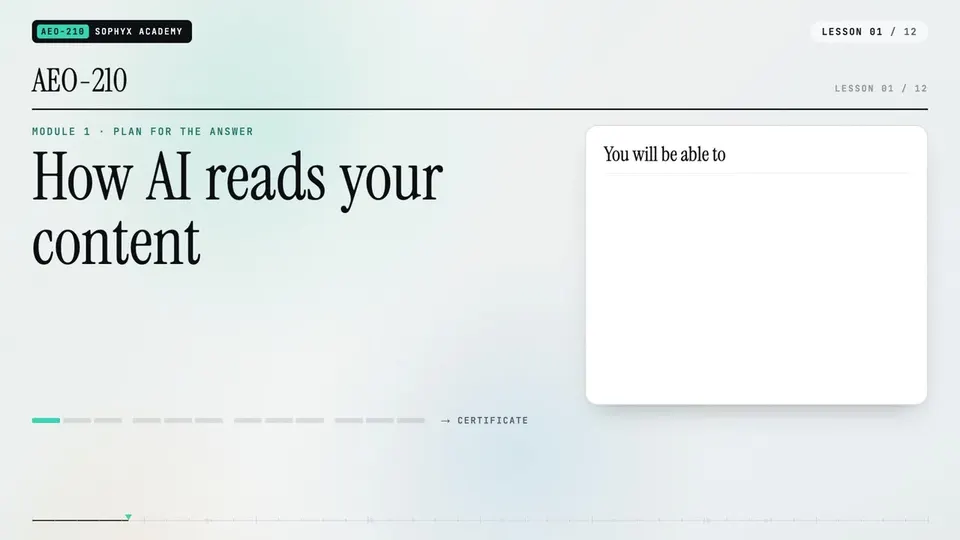
Associate · AEO-210
AEO Content Specialist
Earns: Sophyx Certified AEO Content Specialist – Associate
For content teams: plan, write, prove, refresh and measure pages that AI assistants quote and send buyers to.
- 12 lessons
- 27 min of video
- Free
Flagship course · AE-200
Earn the Certified Answer Engineer credential.
The Answer Engineer is a free video course by Sophyx on getting a brand named in AI answers. In 12 short lessons you learn how ChatGPT, Gemini and other assistants build an answer, how to make your site easy for them to read, how to keep your facts the same everywhere, and how to measure which questions bring you visits.
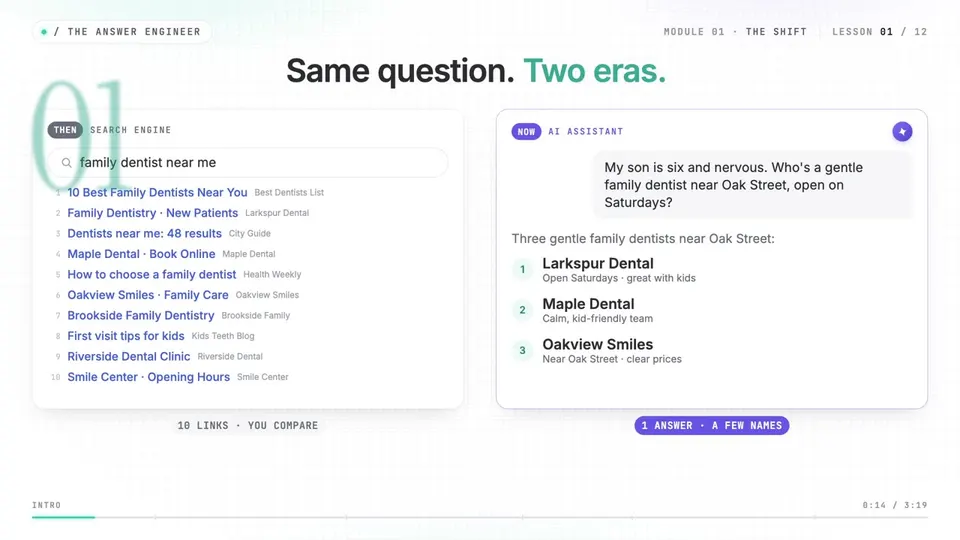
Lesson 1 of 12 · The Answer Engineer
From ten blue links to one answer
Captions, 3:20
Certified Answer Engineer
Verifiable · valid 12 months
You keep hearing that buyers ask AI now. You want a clear picture of how the answer is made and what you can change.
You know crawling, indexing and ranking. You want to know what carries over to AI search, what is new, and how to measure it.
You want your business named when a buyer asks ChatGPT or Gemini, and you want to know which fixes to make first.
You should know basic SEO, meaning what crawling, indexing and ranking are, and have used an AI assistant yourself.
The lessons use fictional businesses, such as Larkspur Dental, a family dental practice. Every brand in the course is fictional and every number is illustrative.
A sample of the 36 objectives across the 4 modules.
Every lesson compares the old way of search, ten blue links, with the new one: one AI answer that names a few brands. Then it shows what to do about it.
4 modules, 12 lessons, about 29 minutes of video. Each lesson has captions, chapters, a transcript and a practice quiz.
Module 1 · 3 lessons ·
Understand it: how AI search differs from classic search, how an answer is made, and what carries over from SEO.
Lesson 1
Classic search crawled, indexed and ranked pages; a person compared ten links and clicked one. AI search fans a full question out into several searches, keeps the passages that answer it, adds what the model learned in training, and writes one answer that names a few businesses. The decision moved from your website (after the click) into the answer (before it). SEO still matters, but ranking is no longer the finish line.
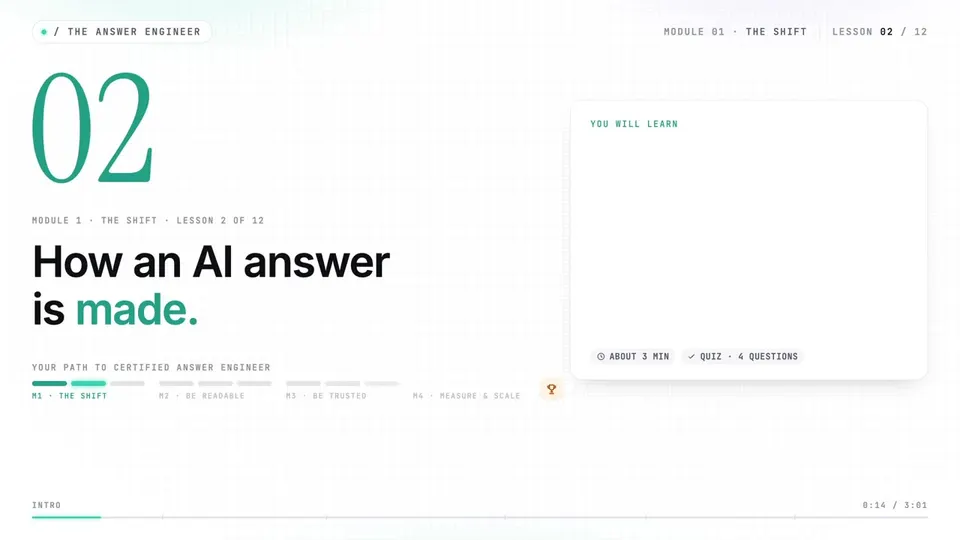
Lesson 2
An assistant answers from two places: what the model learned in training (frozen at a cutoff date) and what it retrieves live. With retrieval, it interprets the prompt, fans it out into searches, pulls pages, splits them into passages, keeps the passages that answer the question, writes a grounded answer and sometimes cites its sources. Passages, not whole pages, are the unit AI works with, and being mentioned is not the same as being cited.
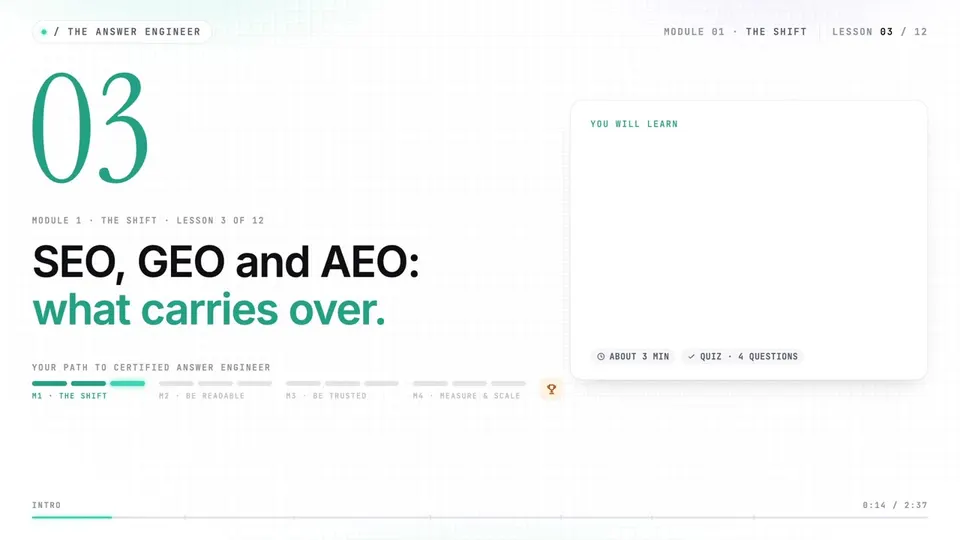
Lesson 3
Much of SEO carries over, with a new meaning. Keywords become prompts. Backlinks become mentions and agreement across many sources. Ranking position becomes share of answer: how often you are named for the prompts that matter. Click-through rate becomes AI referral visits. Crawlability, quality content, clear site structure and authority still form the foundation.
Module 2 · 3 lessons ·
Technical: make sure AI can load your pages, read your facts and quote your content.
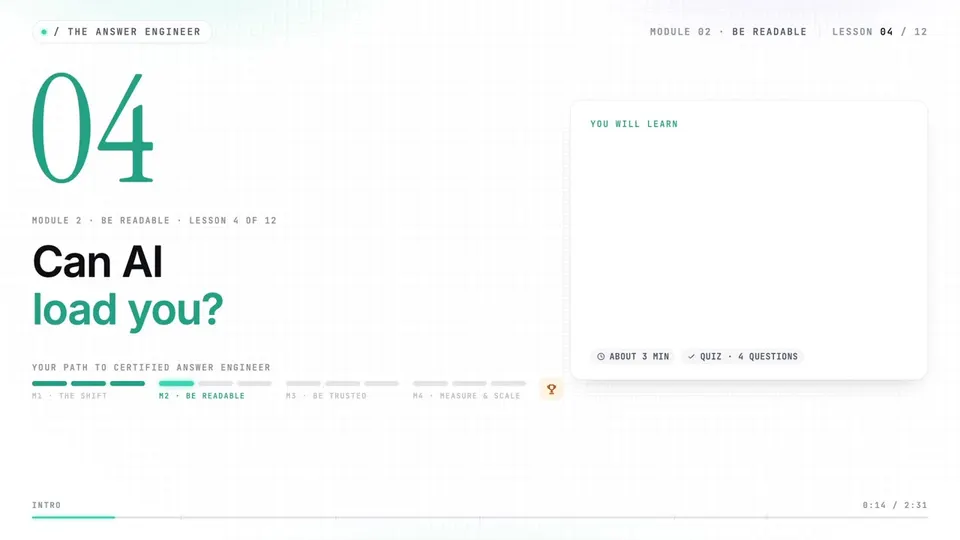
Lesson 4
Before AI can mention you, its crawlers must load your pages. robots.txt decides which crawlers may fetch which paths. Many AI crawlers read the raw HTML and do not run JavaScript, so content that appears only after scripts run may be invisible. Login walls, errors, slow responses and blocked bots stop them too. Some controls are separate: for example, OpenAI lists GPTBot (training) and OAI-SearchBot (search) separately, and Google-Extended governs use for Gemini, not Google Search.
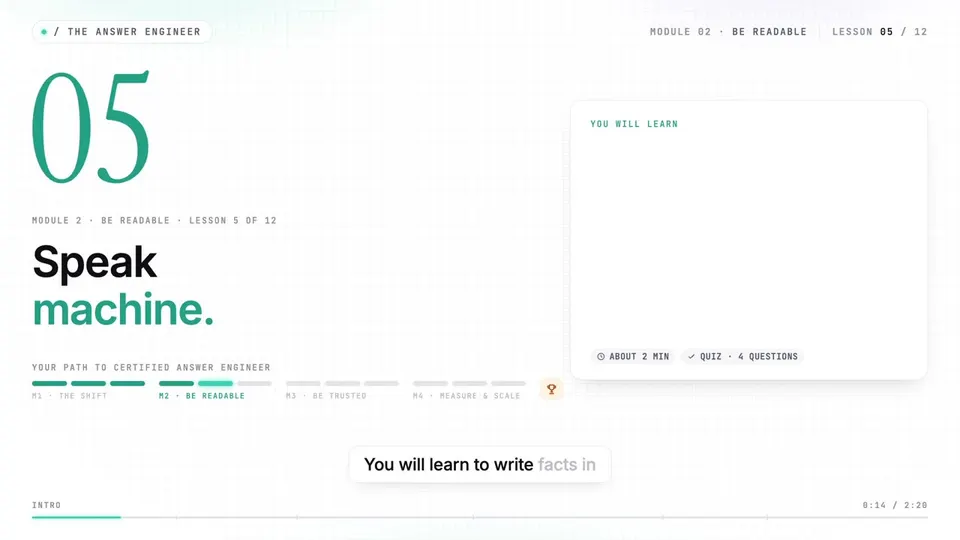
Lesson 5
Make your facts easy for machines to read. Write key facts in plain text on the page. Add schema.org structured data (usually JSON-LD) for your organisation, locations, products, prices, hours and FAQs, and keep it in sync with the visible page. Publish discovery files such as llms.txt and brand.json that point AI to your most important pages and facts. They are emerging conventions and support varies, so they add to plain, consistent facts and do not replace them.
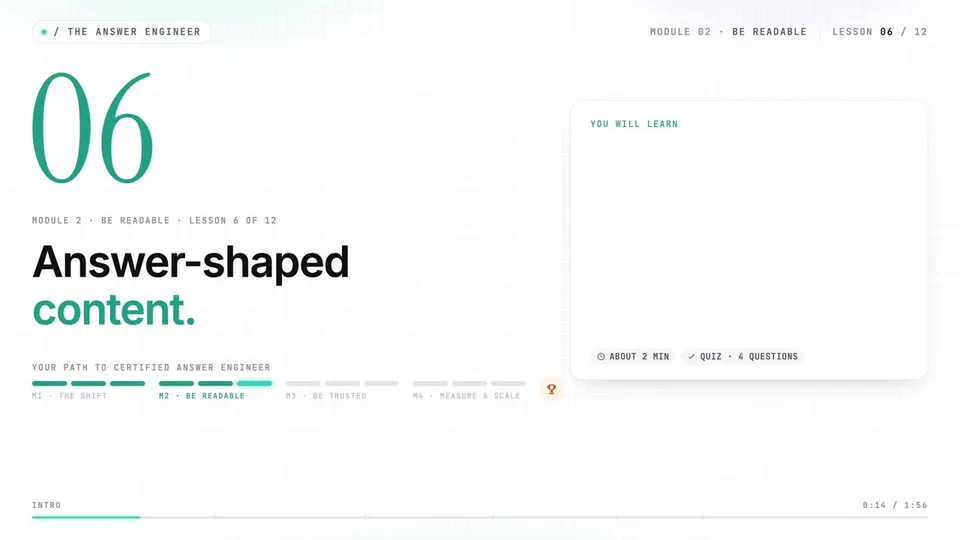
Lesson 6
Write so that any passage can be lifted out and still make sense. Use real questions as headings, put the direct answer in the first one or two sentences, then add detail. Name the subject in each section, include specifics (prices, places, numbers, steps), and use comparison tables, lists and FAQs. Show who wrote it and when it was updated.
Module 3 · 3 lessons ·
Off-site: keep your facts consistent everywhere, earn mentions from others, and keep everything fresh.
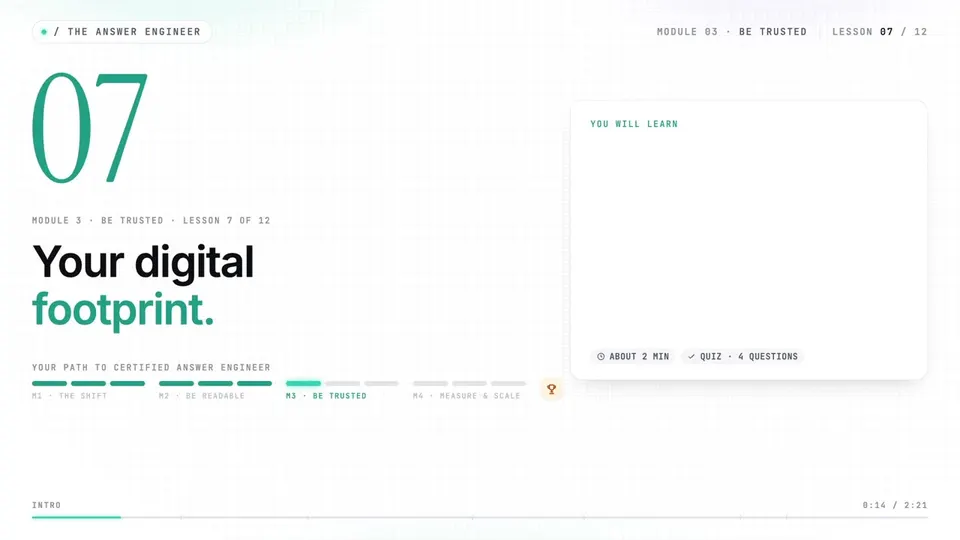
Lesson 7
AI learns about you from everywhere your brand appears: your website, business profiles, directories, review sites, social profiles, marketplaces, Wikidata and more. Keep the core facts identical everywhere: name, address, phone, hours, prices, categories and descriptions. Connect your official profiles to your site with sameAs links in your structured data.
Lesson 8
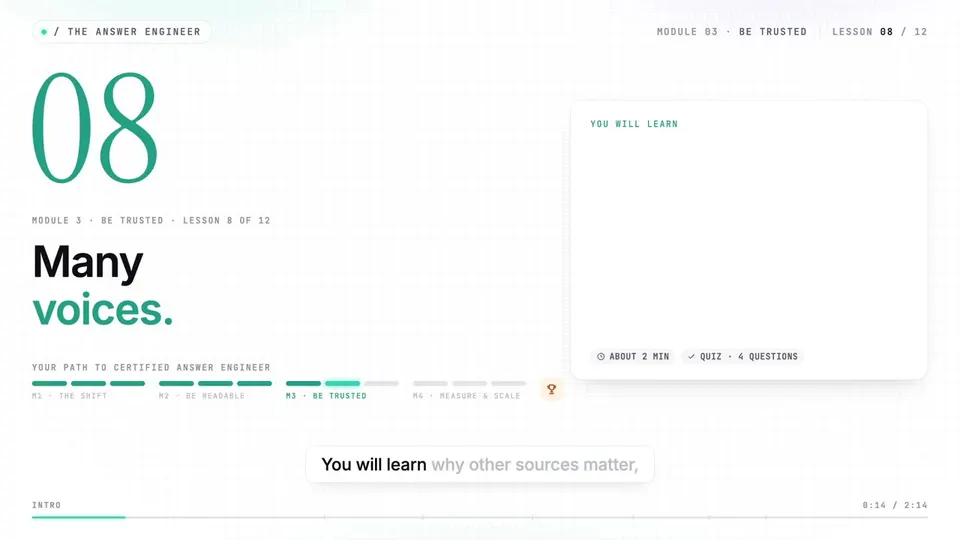
AI trusts agreement. What others say about you, in reviews, social media posts, local news, best-of lists, comparison articles and videos, often matters as much as your own site. Find which third-party sources assistants cite for your prompts, earn honest mentions there, respond to reviews, and correct errors with the publisher. Never buy or fake reviews.
Lesson 9
Stale pages fade, and stale facts get repeated. Watch for answers that give old hours, prices or features, or that are wrong outright (hallucinations). Run a correction workflow: find where the wrong fact comes from, fix it at the source and on your site, update structured data and profiles, then re-check the answers. Review key fact pages on a schedule and whenever something changes.
Module 4 · 3 lessons ·
Operate it: research prompts, measure what wins, and run the answer engineer's loop.
Lesson 10
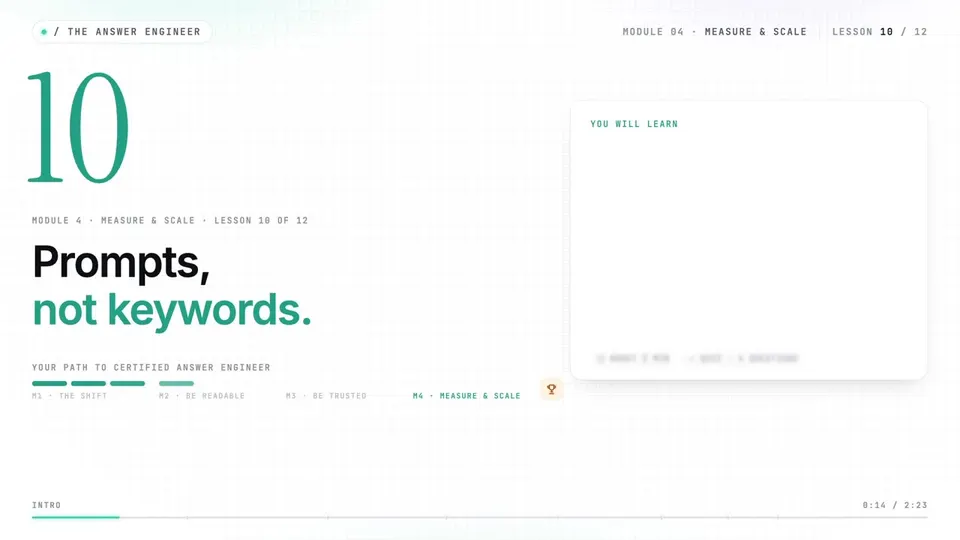
Buyers ask long, specific questions. Build a prompt set from real customer language: sales calls, support tickets, reviews, forums and on-site search. Group prompts by intent (discover, compare, decide), persona and location. Track the same prompts across several assistants, because each can answer differently.
Lesson 11
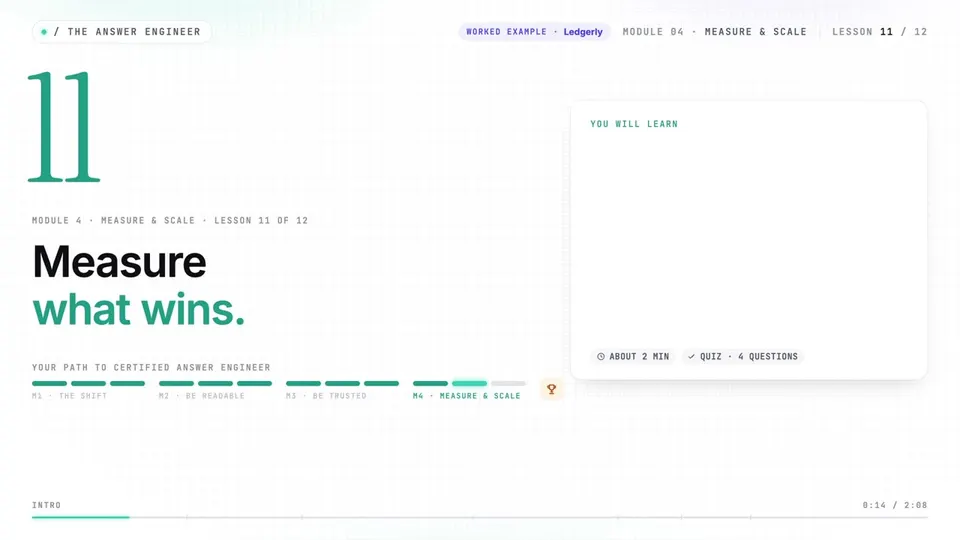
Measure the whole chain: are you mentioned, are you cited, is the answer accurate, do AI crawlers read your pages (server logs), and do people arrive from AI answers (referrals in analytics) and convert? Rank prompts by what their pages actually earned. A prompt can win without being cited, and a cited prompt can bring no one. Visits beat mentions.
Lesson 12
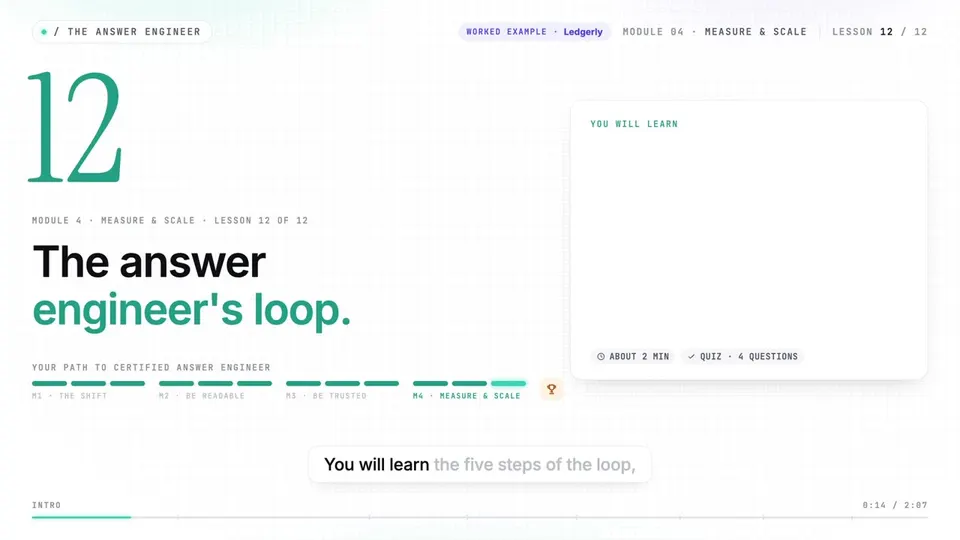
Put it all together as a loop: audit (prompts, answers, loadability, footprint), fix (the highest-impact problems first), publish (answer-shaped pages and corrected facts), measure (mentions, citations, crawler reads, visits) and double down on what wins. Run it on a steady cadence. The capstone project runs one full loop.
Watch, practice, prove, then get certified: the same four steps in every Xlearn by Sophyx course.
Watch all 12 lessons. Each one is about 2 to 3 minutes, with captions, chapters and a transcript.
Take the practice quiz after each lesson. Try as often as you like, and every wrong answer tells you why. You need 3 of 4 right to pass each lesson quiz.
Pass the final exam: 30 scenario questions about different kinds of businesses, 45 minutes, 80% to pass, and 24 hours between attempts. Then a final project, scored against a written rubric with feedback. You can revise and resubmit.
Your certificate gets its own credential ID and a public page anyone can check. Add it to LinkedIn in one click or download the PDF. It is valid for 12 months.
Scenario questions about different kinds of businesses. You can retake it after 24 hours.
Pick a brand: your own, a client's with their permission, or the fictional Larkspur Dental pack. Hand in one deliverable for each part below. Each part is graded pass or fail against a written rubric, and every part must pass. You get written feedback and can revise and resubmit.
Prompt set
20 or more real buyer questions grouped by intent (discover, compare, decide), persona and location, with the source of each question.
Visibility baseline
For each prompt in at least 3 assistants: mentioned or not, cited or not, position, and whether the facts were accurate. Screenshots attached.
Loadability and footprint audit
robots.txt rules for AI crawlers, a no-JavaScript check of key pages, structured data present, and a table of core facts across at least 8 listings with conflicts marked.
Prioritised fix plan
The top 10 fixes ranked by impact on high-value prompts and by effort, each with an owner and a date.
Measurement plan
How you will track AI-crawler reads, AI referral visits and conversions, and how you will decide which prompts are winning and where to double down.
One page that proves what you learned, with a link anyone can open to check it.

Xlearn by Sophyx
Certificate of completion
This certifies that
Your name
has earned the credential
Certified Answer Engineer
for completing the 12 lessons of The Answer Engineer, passing the final exam and passing the final project.
It is a Sophyx credential, not an accredited qualification.
Open a sample certificateMore on how certificates work is on the Xlearn by Sophyx page.
Every course sits on one ladder, from fundamentals to expert. See the courses coming next.
Associate · AEO-210
Earns: Sophyx Certified AEO Content Specialist – Associate
For content teams: plan, write, prove, refresh and measure pages that AI assistants quote and send buyers to.
Professional · GEO-300
Earns: Sophyx Certified Technical GEO Engineer – Professional
For developers and technical SEOs: build a site AI can fetch, read and act on, and keep it that way.
Professional · GEO-310
Earns: Sophyx Certified GEO Analytics Professional
For analytics and growth teams: measure AI visibility from crawler reads to conversions, with numbers you can defend.
Twelve short lessons, free. Finish with a certificate anyone can check.