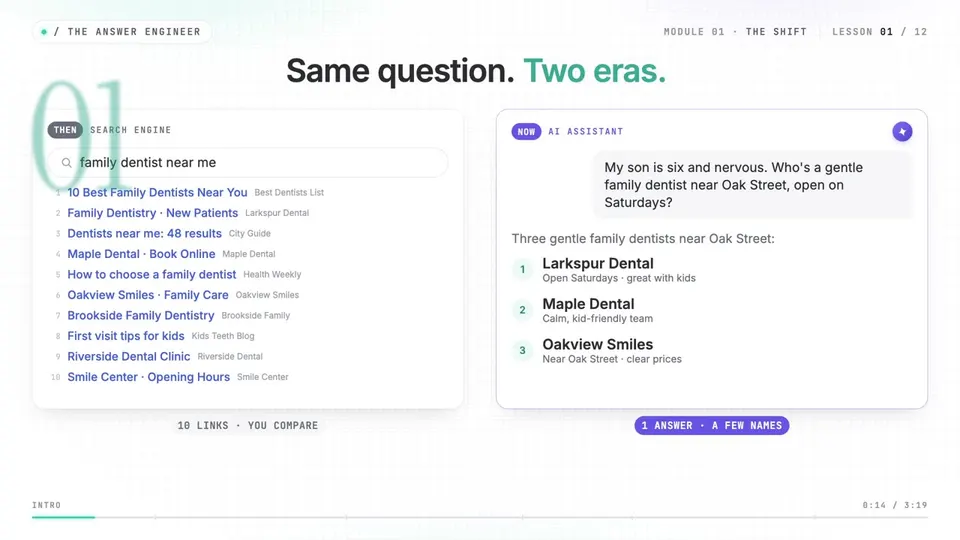
Flagship · AE-200
The Answer Engineer
Earns: Certified Answer Engineer
How AI answers are made, and how to get a brand named in them. The core course, and the place to start.
- 12 lessons
- 29 min of video
- Free
Professional course · GEO-310
Earn the Sophyx Certified GEO Analytics Professional credential.
GEO Analytics Professional is a free 12-lesson video course by Sophyx for growth, analytics and data teams. It teaches you to measure AI visibility end to end, from AI crawlers reading your pages to the bookings that follow, with methods that hold up. It builds on The Answer Engineer, and every lesson works through one fictional company: Wrenfield Physio, a physiotherapy chain in Leeds, York and Sheffield.
Lesson 1 of 12 · GEO Analytics Professional
The AI visibility chain
Captions, 2:57
Sophyx Certified GEO Analytics Professional
Verifiable · valid 12 months
You report the numbers. You want each link of the chain measured where it lives, with ranges you can defend.
You decide where effort goes. You want to know which prompts and pages bring visits and bookings, and what to test next.
You build the pipes. You want server logs, sampled AI answers and web analytics joined at the page.
The Answer Engineer (AE-200) first is recommended, plus some hands-on web analytics. If you already know how AI search works, you can start here.
The lessons follow Wrenfield Physio, a fictional physiotherapy chain with clinics in Leeds, York and Sheffield, and its fictional rival Halbeck Physio. Every brand in the course is fictional and every number is illustrative.
A sample of the 36 objectives across the 4 modules.
Twelve lessons in four modules: what to measure, collecting the data, analysis, then reporting and decisions.
4 modules, 12 lessons, about 36 minutes of video. Each lesson has captions, chapters, a transcript and a practice quiz.
Module 1 · 3 lessons ·
The AI visibility chain and where each link leaves its data; a prompt panel that mirrors buyers; a metric dictionary so every number has one definition.
Lesson 1
AI visibility is a chain of four links: AI crawlers read your pages, assistants mention you or cite your page, people click through, and some visits turn into bookings. Each link leaves its trace in a different place: server logs, sampled answers, web analytics, the booking system. Measure every link where it lives, follow the chain to the link that breaks, and judge it by what comes out the end: visits beat mentions.
Lesson 2
A measurement prompt set is a sample of the questions real buyers ask, not the questions you hope they ask. Build it from calls, support tickets, site search, reviews and sales notes; stratify it by intent (discover, compare, decide) and by segment (city, service, audience); weight each prompt by expected demand; freeze a panel you ask the same way every period, and keep a rotating set for discovery. Version it, so a trend always compares like with like.
Lesson 3
Teams argue about numbers when the definitions live in heads. A metric dictionary writes each metric down once: name, definition, formula, source, grain, period, owner and caveats. The core AI metrics are mention rate, citation rate, share of voice, average position, accuracy, AI referral sessions and AI-assisted key events. Every dashboard, report and experiment uses these definitions and no others.
Module 2 · 3 lessons ·
Sampling AI answers with repeats and intervals; reading and verifying crawler logs; tracking AI referrals in web analytics.
Lesson 4
The same prompt gives different answers on different runs, even with settings that sound deterministic, so a single answer is an anecdote. Sample: ask each prompt several times (5 for a quick look, 10 to confirm, 15 to be rigorous), in clean sessions, spread over days, in each assistant you care about. Report every rate with a confidence interval, and call a change real only when the intervals separate. Log every run.
Lesson 5
A crawler read is a line in your server or CDN logs: IP address, time, request, status, bytes, referrer and user agent. Identify AI crawlers by user agent, then verify them against the published IP ranges, because user agents are easy to fake. Separate three kinds: training crawlers, search indexers and user-triggered fetchers, which mean someone asked about you right now. Then analyse: which pages are fetched, with which status codes, how fresh each key page is, and how volume moves over time.
Lesson 6
AI referral visits land in web analytics, but under several names: referrers such as chatgpt.com, perplexity.ai, gemini.google.com, copilot.microsoft.com and claude.ai; a tag ChatGPT adds to its links; and, as of 2026, an AI Assistant channel in GA4 that excludes Google AI Overviews and AI Mode, which count as organic search. Build one channel that catches them all, watch landing pages, mark key events, and accept that visits from apps that strip the referrer show up as direct.
Module 3 · 3 lessons ·
Joining logs, samples and analytics at the page; attribution beyond last click; benchmarking competitors; experiments with controls and decision rules.
Lesson 7
The three data sets meet at the page. Build a page ledger: for each page, crawler fetches and freshness from the logs, citations from the sampling log, AI sessions and key events from analytics. Then find the break per page: fetched but never cited, cited but never visited, visited but never converting; each has its own fix. For attribution, last click undercounts AI, because an answer often leads to a search or a direct visit later, so triangulate with assisted conversions, branded-search lift and what customers tell you.
Lesson 8
A rate on its own has no scale. Benchmark it against named competitors in the same prompt panel: share of voice, average position, and which domains the answers cite for each brand, including directories and review sites. Watch who is mentioned together with you. Benchmarks need the same intervals as your own numbers, and the useful output is the gap and its cause, not the rank.
Lesson 9
A change followed by a better number proves little: platforms shift, seasons move, and answers vary. Run experiments that hold up: change one thing on a set of pages, keep a control group of similar pages unchanged, measure both before and after (difference-in-differences), use enough runs and weeks to beat the noise, and write the metric, the threshold and the decision date before you start. Judge wins by visits and conversions, not mentions alone.
Module 4 · 3 lessons ·
One-screen dashboards with alerts; winning prompts ranked by earned visits; a decision-first report for leadership.
Lesson 10
A dashboard is for decisions, not decoration. Use the chain as its spine: one row per link with the number, its interval, the change, and the source it came from. Add trend lines with annotations for the changes you made and the changes platforms made. Set a few threshold alerts: key pages no longer fetched, citation share below a floor, AI sessions down for two weeks. Every tile answers "so what, do what".
Lesson 11
Rank prompts by what their pages earned, not by mentions. For each prompt: the pages that serve it, their crawler reads and indexing, the AI and search visits they brought, and the conversions. A prompt can win without being cited; a cited prompt can bring no one. Double down on winners with more prompts like them and more pages; send cited-but-unvisited prompts back to the page, and uncited prompts to the content team as gaps.
Lesson 12
Leadership needs one page: the four links with deltas and intervals, the money (conversions times value, as a range), the decisions taken and the decisions needed, what changed on the platforms and when, and the next experiments. Report ranges, not false precision, and say what you cannot see: visits that arrive as direct, impressions without clicks, citations without visits. Lead with the decision.
Watch, practice, prove, then get certified: the same four steps in every Xlearn by Sophyx course.
Watch all 12 lessons. Each one is about 2 to 3 minutes, with captions, chapters and a transcript.
Take the practice quiz after each lesson. Try as often as you like, and every wrong answer tells you why.
Pass the final exam: 40 questions, 60 minutes, 75% to pass, and 24 hours between attempts. Then a final project, scored against a written rubric with feedback. You can revise and resubmit.
Your certificate gets its own credential ID and a public page anyone can check. Add it to LinkedIn in one click or download the PDF. It is valid for 12 months.
You can retake it after 24 hours.
Pick a brand: your own, a client's with their permission, or the fictional Wrenfield Physio data pack. Hand in one deliverable for each part below. Each criterion is scored from 0 to 3 against its descriptor, and you pass with a 2 or higher on every one. Two graders score one in ten submissions, to keep scoring fair. You get written feedback and can revise and resubmit.
Chain and sources (M1)
The four links named and each mapped to the system it is read from, with the biggest drop identified.
Prompt panel (M1)
A stratified, weighted, versioned panel of at least 40 prompts sourced from buyers.
Metric dictionary (M1)
At least 8 metrics with formula, source, grain, period, owner and caveats.
Sampling log (M2)
At least 20 prompts × 5 runs in 2 or more assistants, in clean sessions, with confidence intervals.
Crawler-log analysis (M2)
One month of logs: AI user agents verified against published IP ranges, fetches per page, status codes, freshness.
AI referral channel (M2)
One channel rule covering the AI referrers and tags, landing pages by AI source, two key events.
Page ledger (M3)
At least 20 pages joining fetches, citations, AI sessions and key events, with the break marked per page.
Competitor benchmark (M3)
Share of voice, position and citation share by domain for 3 rivals taken from the answers, with intervals.
Experiment design (M3)
Test and control pages, one change, a baseline, and a decision rule written before the start.
Dashboard (M4)
One screen: the four links with intervals and deltas, annotated trends, two threshold alerts with owners.
Winners table (M4)
At least 20 prompts with pages, reads, AI and search visits and conversions; winners, leaks and gaps marked.
Leadership report (M4)
One page: decisions first, the four links as ranges with sources, the money, the unknowns, next experiments.
Honesty and labelling
Fictional brands and illustrative numbers labelled; no number without its source and interval; limits stated.
One page that proves what you learned, with a link anyone can open to check it.

Xlearn by Sophyx
Certificate of completion
This certifies that
Your name
has earned the credential
Sophyx Certified GEO Analytics Professional
for completing the 12 lessons of GEO Analytics Professional, passing the final exam and passing the final project.
It is a Sophyx credential, not an accredited qualification.
Open a sample certificateMore on how certificates work is on the Xlearn by Sophyx page.
Every course sits on one ladder, from fundamentals to expert. See the courses coming next.
Flagship · AE-200
Earns: Certified Answer Engineer
How AI answers are made, and how to get a brand named in them. The core course, and the place to start.

Associate · AEO-210
Earns: Sophyx Certified AEO Content Specialist – Associate
For content teams: plan, write, prove, refresh and measure pages that AI assistants quote and send buyers to.
Professional · GEO-300
Earns: Sophyx Certified Technical GEO Engineer – Professional
For developers and technical SEOs: build a site AI can fetch, read and act on, and keep it that way.
Twelve short lessons, free. Finish with a certificate anyone can check.