Agentic Commerce: get your products picked when AI agents shop
A free course in twelve short lessons, with low code: write the facts agents check, build feeds and labels from one source, switch on a checkout agents can finish, then count agent orders and improve every month.
A shopping agentExample run
The buyer's request
“Find me a 12-inch stainless steel pan for induction, under $150, delivered by Friday. Buy it if it fits.”
The agent checks each must-have against each pan's facts
Must-haves
BrindlewoodTri-Ply Skillet
PellmontClad Pan
12-inch
passes
passes
Stainless steel
passes
passes
Works on induction
passes
passes
Under $150
passes$129
passes$136
Arrives by Friday
passesShips fast!Thursday
passesThursday
The agent
Picked
Ranked 2nd
Both pass all five, so the agent ranks them on price.
Brindlewood's page, delivery
Theo's fix
Ships fast!
Weekday orders by 2 pm Eastern ship today
2–5 business days, free over $75
Buy it?Stop
Brindlewood Tri-Ply Skillet$129.00
Tax$10.32
Delivery, arrives ThursdayFree
Total$139.32
No money moves until the buyer says yes.
Example from the course: Brindlewood Kitchen and Pellmont Cookware are made-up online shops, and the numbers are illustrative.
Regular price USD 89. Your first certification is free. Free with any paid Sophyx plan. Certificates take up to 30% off your plan. See plans
short video lessons
12
minutes of video
39
questions in the final exam
40
months the certificate is valid
12
Four modules, one checklist
Every lesson follows Theo at Brindlewood Kitchen as he gets the shop ready for AI shopping agents, and each module adds a section to your own agent-ready checklist.
Theo's agent test · 10 runs
“Find me a 12-inch stainless steel pan for induction, under $150, delivered by Friday. Buy it if it fits.”
Lesson 1 · the page says “Ships fast!”
1of 10 runs pick the skillet
Module 1
How AI agents shop
An agent turns a buyer's request into must-haves, checks each one against facts it can read, and drops a product it can't check. So every best-seller gets a fact sheet in plain text, with one value everywhere and an owner for each fact.
Feed row, checked against the page
title
Brindlewood Walnut Knife Block, holds 7 knives
price
79.00 USD
availability
in_stock
gtin
09506000134383
return_days
30
Weekly feed: 41 shoppers met a sold-out page
Module 2
Data agents can use
Build every product feed, the file that lists your products and their facts, from one source, and send price and stock within minutes. Labels on the page match what it shows, and every variant gets its own ID, barcode number (GTIN), stock and link.
The checkout's reply to the agent
10-inch Tri-Ply Skillet$109.00
Standard delivery, Tue–ThuFree
Tax$8.72
Total, before the yes$117.72
The buyer approves $117.72
Token: max $117.72, 10 min
Brindlewood stays the seller
Module 3
Agent checkout
Switch on a checkout an agent can finish while you stay the seller: the full total before the buyer's yes, nothing pre-ticked and nothing added after. Let verified shopping agents in, and keep the same fraud checks on every order.
October · three streams, three places
AI referralsWeb analytics31orders
Agent visitsBot management log9,800visits
Agent ordersOrder system212orders
31AI orders, says web analytics
Module 4
Measure and improve
Count agent orders in the order system, because they never load a page. Read returns and disputes by channel, then run an agent test and a freshness check every month, and fix one thing at a time.
One value for every fact
When your feed says one price and your page another, an agent can't tell which is true. It may skip the product, use the worse value or pick a rival whose facts agree. In the course you fix each fact at its source and give it an owner.
Find where each fact is stored, and correct it there
Update or remove every stale copy, such as an old FAQ page
Name an owner who checks every place an agent reads the fact
Conflict list12-inch skillet
One source: the store platform's product dataPage, feed and listing agree
Price
Owner: Theo
Page
$129
Feed
$109$129
The feed now reads from the product data
Returns
Owner: Hana
Policy page
30 days
Old FAQ, listing
14 days30 days
FAQ corrected, listing reads from the source
Delivery
Owner: the warehouse lead
Page
2–5 business days
Marketplace
5–7 business days2–5 business days
The listing now reads from the product data
Next ten agent tests: the skillet is picked in 6
Theo's conflict list for the skillet, from lesson 3.
The full total before the buyer's yes
A buyer's limits travel with the agent: the item, the shop, the most it may spend and the date. When the total passes the limit, the agent stops and asks, and the buyer may buy somewhere else. Rules on prices, fees and checkout design differ by country, so check your local rules.
Price, tax, delivery and every fee in the first total
Nothing added after the yes: any change goes back to the buyer
Extras start unticked, with no late fees or false urgency
Checkout · knife blockAn agent's order
The buyer's limits, carried by the agent
Walnut Knife Block
From Brindlewood Kitchen only
At most $90 with tax and delivery
Buy by Sunday
Walnut Knife Block$79.00
Care kit, pre-tickedNow offered unticked, after the item$9.00
Packaging feeGone$4.99
DeliveryFree
Tax$7.44$6.32
Total, before the yes$100.43$85.32
Limit $90
Inside the limit: the full total first, waiting for the buyer's yes.
31agent checkouts stopped in a month
2the month after the fix
Theo's knife block checkout, from lesson 8.
Returns show which fact was missing
A buyer who orders through an agent never sees your page. They know only what the agent passed on, so a fact it didn't have comes back as a return. In the course you read returns by channel and turn each reason into a fact.
Judge agent sales after returns and disputes
Add each missing fact to the page, the labels and the feed
Keep a record of what each buyer approved, for disputes
Returns by channel12-inch skillet
Share of orders returned
Website ordersSept and Oct5%
Agent ordersNovember16%6%
Top return reasons, agent orders
“Much heavier than I expected”
“Too long for my cabinet”
What the agent passed on to its buyers
“12-inch tri-ply skillet, induction-ready, $129”
Weight
3.4 lb
Length with the handle
21 inches
Added toPageLabelsFeed
Theo's skillet returns, from lesson 11.
The syllabus
4 modules, 12 lessons, about 39 minutes of video. Each lesson has captions, chapters, a transcript and a practice quiz.
Before you start
Answer Engine Specialist (AE-200) first is recommended, not required. No programming: you read and edit plain structured data, such as a feed row, a page's product facts and a checkout setting, and the lessons say when to hand a change to a developer. Checkout and consumer rules differ by country and change, so check your local rules. The course is not legal advice, and finishing it does not make anyone compliant with any law.
Worked example
The lessons follow Theo, the e-commerce manager at Brindlewood Kitchen, a fictional online shop for cookware and kitchen knives, and its fictional rival Pellmont Cookware. The assistants, shopping agents, store platform and payment provider on screen are generic ones. Every brand in the course is fictional and every number is illustrative.
1
Module 1 · 3 lessons ·
How AI Agents Shop
From AI answers that name products to assistants that compare and link out and agents that buy within the buyer’s limits; how an agent turns a request into must-haves, checks each against facts it can read, drops what fails or can’t be checked and stops for the buyer’s approval before paying; the facts agents compare and where they read them (feed, page, checkout, other sites), written in plain text on a fact sheet; and why two values for one fact make an agent skip a product, fixed at the source with an owner for every fact.
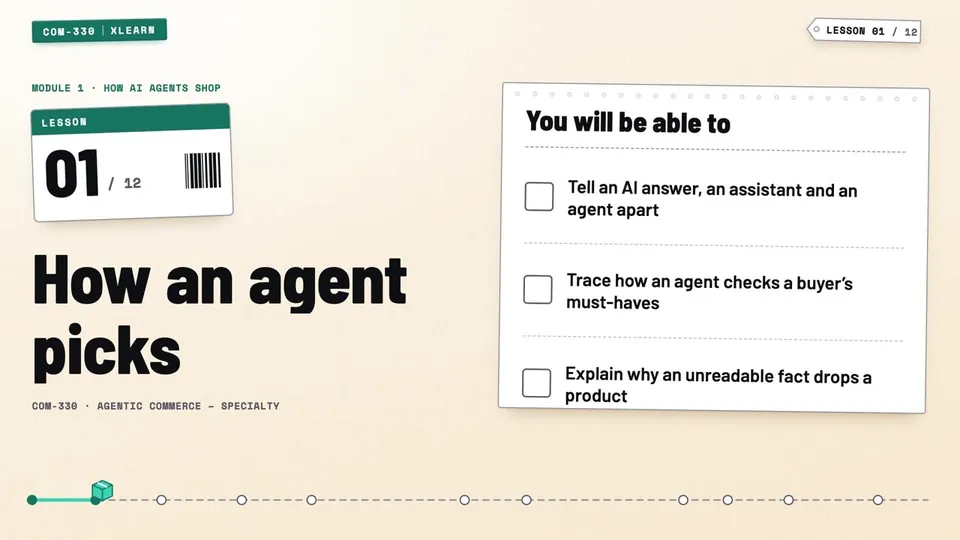
AI shopping comes in three kinds: an AI answer names a few products, an assistant compares them and sends the buyer to a shop, and an agent buys within the limits the buyer set. An agent turns the request into must-haves, reads each candidate’s facts, checks every must-have, drops any product that fails one or whose fact it can’t find, ranks the rest by price, reviews or delivery, and stops to show the buyer its pick and the full total before any money moves. A better product with one unreadable fact loses to a weaker one whose facts are complete. Worked example: a buyer asked for a 12-inch induction pan under $150 delivered by Friday; Brindlewood’s skillet met every must-have, but its page said only “Ships fast!”, so the agent picked a rival’s pan; Brindlewood was picked in one of ten agent tests.
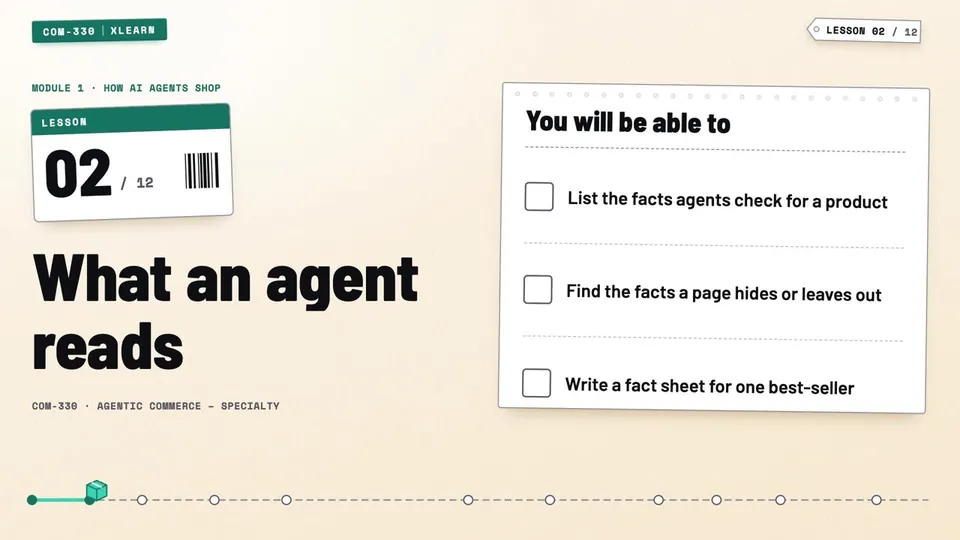
Agents compare products on checkable facts, not adjectives: who makes it, the price and stock, the delivery and return promises, the specs that matter for that kind of product, and the reviews (rating and count). They read them in the product feed, on the product page, at checkout and on other sites that sell or review the product. A fact shown only in a photo, a PDF or behind a footer link may never be read, so each fact goes on the page in plain text with its number and unit, and each best-seller gets a fact sheet listing its facts and where each lives. Worked example: the skillet’s page answered 7 of 12 buyer questions; delivery, returns, induction, the oven limit and the barcode number were hidden or missing until all 12 were written into the page.
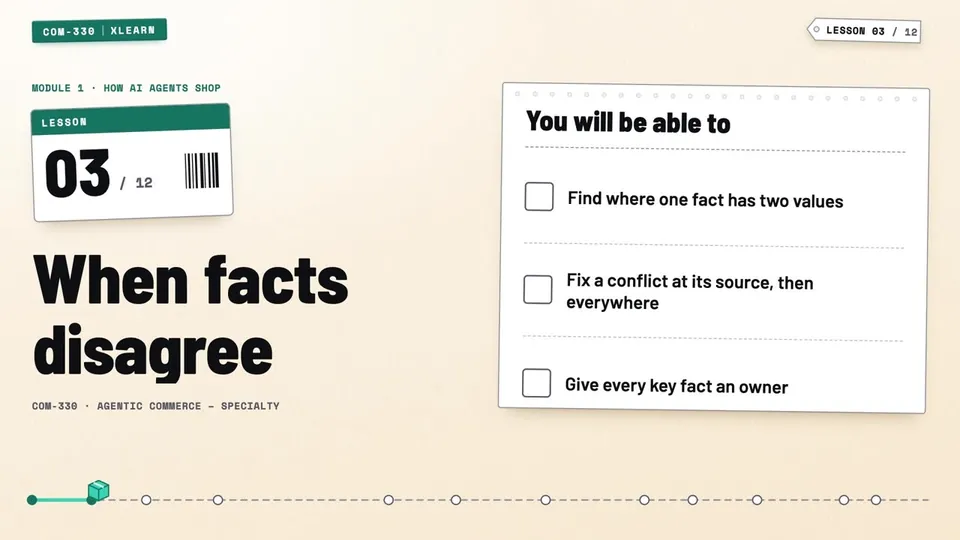
When two places give one fact different values (the feed and the page, a policy page and an old FAQ, the site and a marketplace listing), an agent can’t tell which is true: it may skip the product, use the worse value or pick a rival whose facts agree. Fix each fact where it is stored and let the page, the feed and the listings read from that one source; update or remove stale copies; name an owner for every key fact, who checks every place an agent reads it when it changes; never show bots a different version from people. Worked example: the feed (a hand-kept spreadsheet) still had an expired $109 sale price against $129 on the page, an old FAQ and a marketplace listing said 14-day returns against 30, and the listing said 5–7 days delivery against 2–5; after the fixes the skillet was picked in six of ten agent tests.
2
Module 2 · 3 lessons ·
Product Data Agents Can Use
Product feeds for AI shopping surfaces: the shared core of fields, delivery and return details and the checkout flag, built from one product data source with price and stock pushed within minutes; product facts on the page labelled with structured data (product, offer, delivery, returns) that match the visible page, with store-wide policies and marked exceptions; GTINs assigned by the brand owner, and every variant with its own ID, GTIN, price, stock, photo, link and title inside a product group.
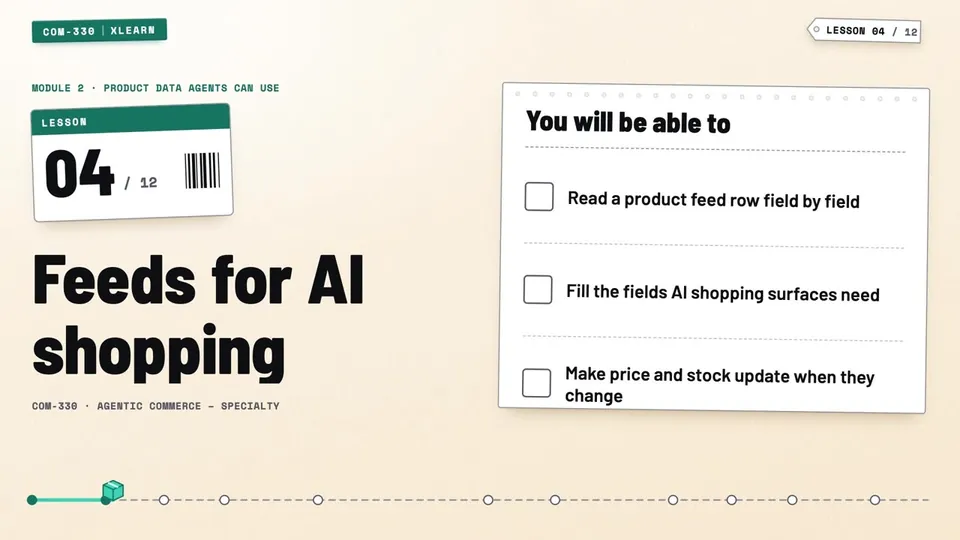
A product feed is a file or live connection that lists every product’s facts in fixed fields for AI shopping surfaces. Each surface publishes its own spec, but the core is shared: an ID, a title, a description, a link, an image, the price, the stock and the brand, with the barcode number (GTIN) where there is one, then delivery and return details and a flag that says whether agents may buy. Whatever the feed says, an agent may repeat it to a buyer, so every feed is built from the one product data source the page uses, a full feed goes out daily, and price and stock changes are pushed within minutes. Worked example: a weekly feed kept a sold-out knife block “in stock” for five days and sent 41 shoppers to a sold-out page; the new set-up sends changes within fifteen minutes.
On the product page each fact is written in plain text for people and labelled with structured data for machines: a product label (name, brand, GTIN, image), an offer (price, currency, stock, condition), delivery labels (cost, handling and transit time) and return labels (window, method, who pays, refund). Labels must match what the page shows; a label that says more or something different breaks trust and can get a listing flagged. Store-wide return and shipping policies are written once for the store, with exceptions marked on the products they cover, and every label is generated from the same data as the page. Worked example: an old theme labelled every product $119 and “in stock”; 23 price mismatches were flagged until the developer generated the labels from the product data.
A GTIN is the global barcode number for one exact product; agents and shopping platforms use it to know that two listings are the same product. The brand owner assigns it from its GS1 company number, so it is never invented, copied or reused. A variant is one version of a product, such as a size or a colour: each gets its own ID, GTIN, price, stock, photo, link and a title that names the difference, grouped in one product group. Shared records share one stock count, so agents order versions that are sold out. Worked example: two knife handles shared one listing, one stock count and a walnut photo; agents ordered walnut, sold out for three weeks, and nine orders were cancelled; split into two variants, each with its own GTIN and stock.
3
Module 3 · 3 lessons ·
Checkout an Agent Can Finish
Agentic checkout as a handshake with the shop’s own system (the real total and delivery options, the buyer’s approval, a one-time token capped in amount and time, the order and its updates), with the shop as merchant of record and only ready products switched on; the buyer’s limits, the full final total before approval, nothing added after it, changes sent back to the buyer and no dark patterns, with local rules checked; and letting signed, verified shopping agents through while unknown automation is challenged and fraud checks run on every order.
In an agent checkout the agent talks to the shop’s own checkout system: it asks for the real total and the delivery options, shows them to the buyer and waits for a yes, then pays with a one-time token capped at the approved amount and valid for minutes. The shop stays the merchant of record: its payment provider takes the payment, its fraud checks run, it creates the order, sends updates (confirmed, shipped, delivered) and handles returns, refunds and support. A checkout can hand the buyer to the shop’s own page when it needs their input. Switch it on only for products and policies that are ready (not personalised, made-to-order or pre-order items), and test one order end to end. Worked example: 120 of 150 variants switched on; a $117.72 order arrived without touching the website.
An agent may buy only within the limits the buyer set: the item, the price, the shop and the time; the payment it carries is capped to match. The checkout gives the full final total with tax, delivery and every fee before the buyer approves, adds nothing after the yes, and sends any change in price, stock or delivery back to the buyer instead of charging. No dark patterns for people or agents: extras start unticked, fees appear in the first total, urgency claims are true. Rules on prices, fees and checkout design differ by country; check your local rules (not legal advice). Worked example: a pre-ticked $9 care kit and a $4.99 packaging fee pushed a $79 knife block to $100.43 against a $90 limit; 31 agent checkouts stopped in a month, 2 after the fix.
Automated visitors include price scrapers, card testers trying stolen cards, and shopping agents sent by real buyers; a blocked agent can’t buy, so a blanket block turns away customers along with the attackers. More and more shopping agents sign their requests so bot management can check who runs them: let verified shopping agents reach product pages, carts and checkout, and challenge and slow automation that can’t be identified. A verified agent proves who runs it, not who the buyer is, so the same fraud checks run on every order, with extra checks on unusual ones. Worked example: a sale-day block failed 37 agent checkouts; at the next sale no verified agent was turned away, and fraud checks stopped 26 stolen-card orders.
4
Module 4 · 3 lessons ·
Measure and Improve
Three AI sales streams counted where they land (AI referrals in web analytics, agent visits in bot management logs, agent orders in the order system by channel tag) and a monthly AI sales report; returns and disputes by channel, return reasons turned into facts, refunds through the shop’s own payment provider and approval records kept as evidence; and a monthly loop of agent tests and freshness checks, one fix at a time, run again after every platform, app or policy change.
AI brings sales three ways, each counted in a different place: AI referrals (people who click from an AI answer, seen in web analytics), agent visits (agents browsing for a buyer, seen in bot management and logs) and agent orders (placed through agent checkout without loading a page, so the analytics tag never fires; counted in the order system by a channel tag on every order). A monthly AI sales report puts the three streams side by side with revenue and average order value, plus the products agents pick most and never pick; skipped products usually point to a missing fact. Worked example: analytics showed 31 AI orders, the order system 243 of 2,400, 212 of them through agent checkout.
An agent order counts only once it stays sold. Track returns and disputes by channel and judge agent sales after both. A buyer who ordered through an agent never saw the page and knows only what the agent passed on, so return reasons point to missing facts that belong on the page, in the labels and in the feed. The shop stays merchant of record: it refunds through its own payment provider and sends the status back to the agent, and it keeps each order’s approval record (item, approved total, time, capped token) as evidence for as long as a dispute can be raised. Worked example: agent returns on the skillet were 16% against 5% on the site (“heavier than expected”); with weight and length added they fell to 6%; two disputes with approval records were won, and one without was lost.
Agent readiness is never finished. Every month, run an agent test (real buyer requests in the assistants buyers use, recording picks, prices and delivery dates) and a freshness check comparing price, stock, barcode numbers and policies across the page, labels, feeds, listings and checkout; run the checks again after any platform, app or policy change. Fix the biggest gap at its source, one thing at a time, and measure the change in picks, orders and returns. Keep the agent-ready checklist current so anyone on the team can run the loop. Worked example: an app update dropped the knife’s GTIN from the feed and its picks fell from six in ten to two; the field was restored and picks returned to six; a price change reached five places in fifteen minutes.
Watch, practise, prove it, then get certified: the same four steps in every Xlearn by Sophyx course.
1
Watch
Watch all 12 lessons. Each one is about 2 to 3 minutes, with captions, chapters and a transcript.
2
Practice
Take the practice quiz after each lesson. Try as often as you like, and every wrong answer tells you why.
3
Prove
Pass the final exam: 40 scenario questions about different kinds of businesses, 60 minutes, 75% to pass, and 24 hours between attempts. Pass it and the certificate is yours.
4
Get certified
Your certificate gets its own credential ID and a public page anyone can check. Add it to LinkedIn in one click or download the PDF. It is valid for 12 months.
Final exam
Scenario questions about different kinds of businesses. You can retake it after 24 hours.
questions
40
minutes
60
to pass
75%
Your certificate
One page that proves what you learned, with a link anyone can open to check it.
Xlearn by Sophyx
Certificate of completion
Sample
This certifies that
Your name
has earned the credential
Sophyx Certified Agentic Commerce – Specialty
for completing the 12 lessons of Agentic Commerce Specialty and passing the final exam.
Code
COM-330 · Specialty
Valid
12 months
Credential ID
COM-330-26-4P8V2KXR
Verify at
sophyx.io/verify/COM-330-26-4P8V2KXR
Verified
Sample certificate. Yours carries your name and its own credential ID.
A unique, random credential ID
A public verification page anyone can open
One-click Add to LinkedIn
A PDF you can download and share
Valid for 12 months
It is a Sophyx credential, not an accredited qualification.
The discount lasts while your certificates are valid. A new certificate never lowers the discount you have. It applies to Pro, Agency Lite and Agency Pro.
Agentic Commerce Specialty (COM-330) is a free 12-lesson video course by Sophyx for e-commerce and product teams. It teaches how AI shopping agents pick products and why they drop one they can't check, how to give them facts, feeds and labels that agree everywhere, how to switch on a checkout an agent can finish safely, and how to count what agents bring. It ends with the Sophyx Certified Agentic Commerce – Specialty certificate.
Who is it for?
E-commerce managers, catalog and product-data managers, marketplace marketers and founders of online shops. It is low code: you read and edit plain structured data, such as a feed row, a page's product facts and a checkout setting, and the lessons say when to hand a change to a developer.
Do I need Answer Engine Specialist first?
It is recommended, not required. You should know that AI trusts facts that agree and reads plain text and structured data, which Answer Engine Specialist (AE-200) covers.
What does it cover?
Four modules. How AI agents shop: how an agent turns a request into must-haves and drops what it can't check, the facts it reads and where, and what happens when facts disagree. Product data agents can use: feeds built from one source and kept fresh, labelled facts that match the page, and a GTIN and a record of its own for every variant. A checkout an agent can finish: the shop stays the seller, the buyer sees the full total before saying yes, the agent stays inside the buyer's limits, and verified agents get in while fraud checks keep running. Measure and improve: agent orders counted in the order system, returns and disputes read by channel, and a monthly agent-ready loop.
Is the course legal advice?
No. Some lessons touch consumer rules on prices, extras, delivery and returns in the United States, the United Kingdom and the European Union. The course teaches the principles, such as a true total before payment and nothing extra without a clear yes, and names each rule with its place and date. Rules change, so check your local rules before you act, and ask a lawyer when the decision is a legal one. Finishing the course does not make anyone compliant with any law.
What is the worked example?
Brindlewood Kitchen, a fictional online shop for cookware and kitchen knives, and its fictional rival Pellmont Cookware. In lesson 1, a shopping agent leaves out Brindlewood's skillet although it fits every wish, because its page says only "Ships fast!" and the agent can't check that it arrives by Friday. All brands and people in the course are fictional and all numbers are illustrative. Standards and platform details are stated as of October 2026.
How long does it take?
There are 12 lessons and about 39 minutes of video, each lesson with a practice quiz. Then comes the final exam.
What is the final exam like?
The final exam has 40 questions, a 60-minute limit and a 75% pass mark, with 24 hours between attempts. Most questions are scenarios about running different kinds of online shops.
Is the certificate an accredited qualification?
No. It is a Sophyx credential, not an accredited qualification, and it does not come from a university or a government body. It shows that you watched the course, took the practice quizzes and passed the final exam. Anyone can check it on its public verification page, and it is valid for 12 months.
Is it free?
Your first certification is free. Free with any paid Sophyx plan. The regular price of Agentic Commerce Specialty is USD 89.