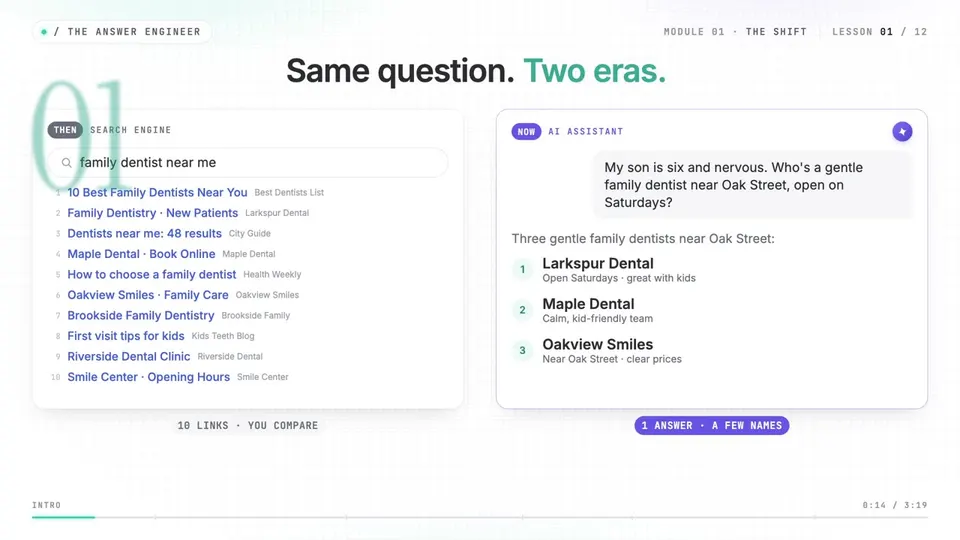
Flagship · AE-200
The Answer Engineer
Earns: Certified Answer Engineer
How AI answers are made, and how to get a brand named in them. The core course, and the place to start.
- 12 lessons
- 29 min of video
Regular price USD 89, free for a limited time.
Specialty course · REP-320
Earn the Sophyx Certified AI Reputation – Specialty credential.
AI Reputation Specialty is a free 12-lesson video course by Sophyx for PR, communications and brand teams. You learn to find out what AI assistants say about a brand and why, fix what is wrong at its source, earn trust through honest reviews, earned media and open community work, and handle old crises, fakes and errors with a clear routine. Where review and disclosure rules come up, it teaches the principles and tells you to check your local rules. It is not legal advice. It builds on The Answer Engineer, and every lesson works through one fictional company: Quillmere Hotels, a boutique hotel group with four hotels.
Regular price USD 89, free for a limited time.
Every lesson, the exam, the project and the certificate are free while the offer runs.
Lesson 1 of 12 · AI Reputation Specialty
Where AI gets its opinion
Captions, 2:36
Sophyx Certified AI Reputation – Specialty
Verifiable · valid 12 months
You answer for what is said about the brand. You want to know what AI assistants say, where each claim comes from, and how to respond when an old crisis or a fake comes back.
You look after reviews, profiles and the facts on record. You want one dated facts page that every profile agrees with, and a review program that asks every customer.
You speak for the brand in forums and threads. You want to reply with facts, say who you are in the first line, and follow each community's rules.
The Answer Engineer (AE-200) first is recommended. No technical background is needed: where a fix needs code, you write a brief for your web team. The course teaches principles and is not legal advice. Review and disclosure rules differ by country and change, so check your local rules before you act.
The lessons follow Quillmere Hotels, a fictional boutique hotel group with four hotels, and its fictional rival Caskwell Hotels. Every brand in the course is fictional and every number is illustrative.
A sample of the 36 objectives across the 4 modules.
Twelve lessons in four modules: how AI forms an opinion, fixing what it gets wrong, earning trust, then risk and response.
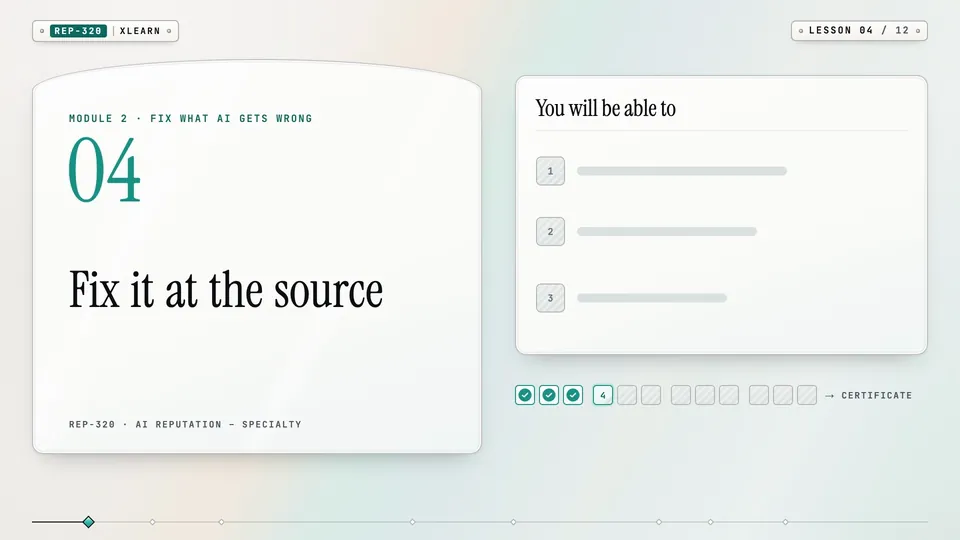
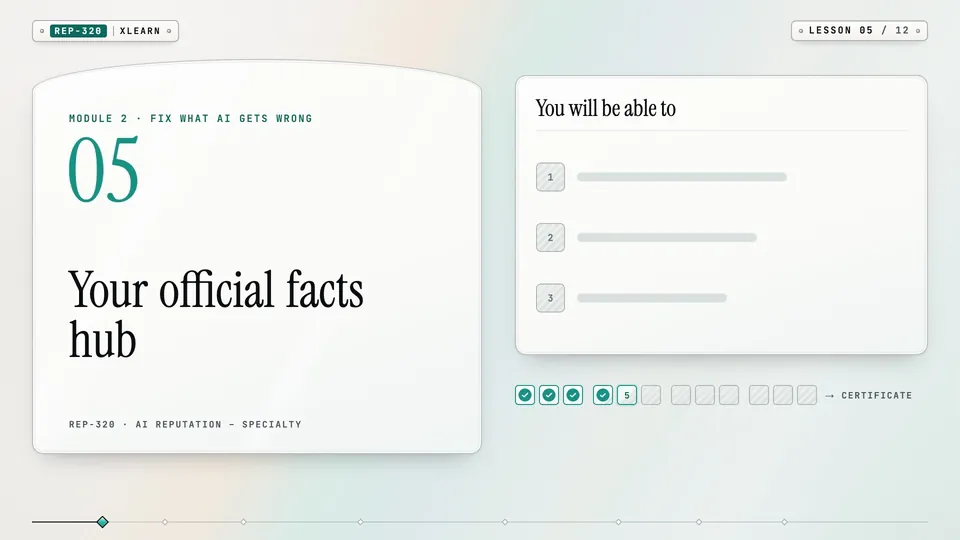
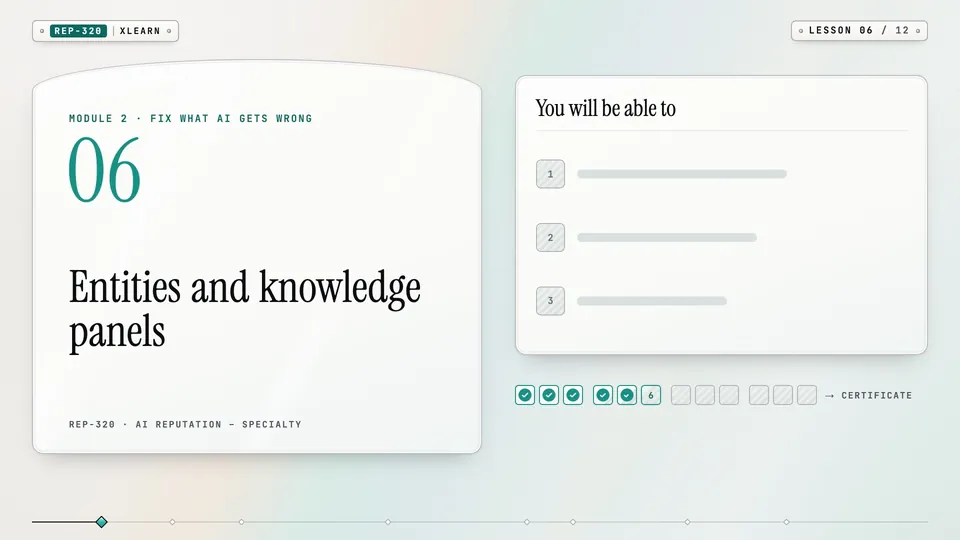
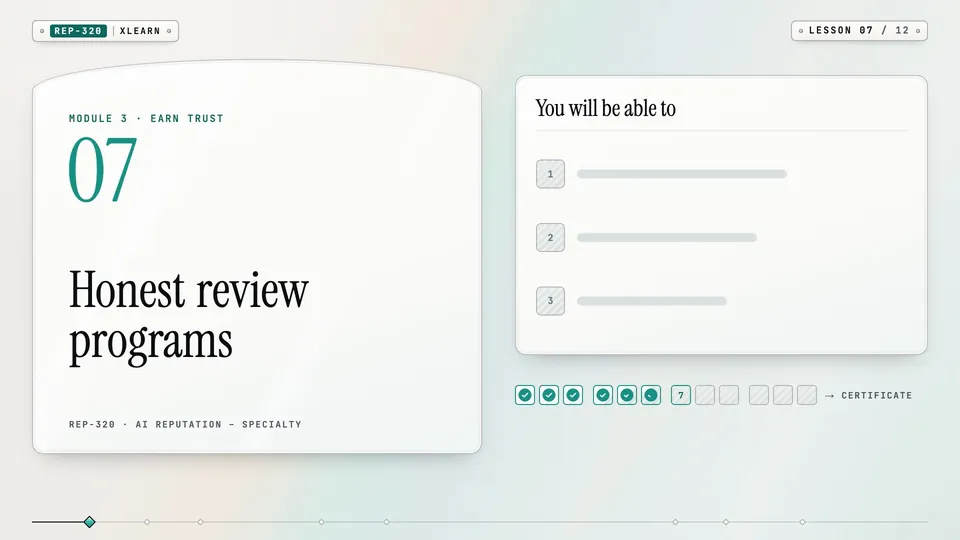
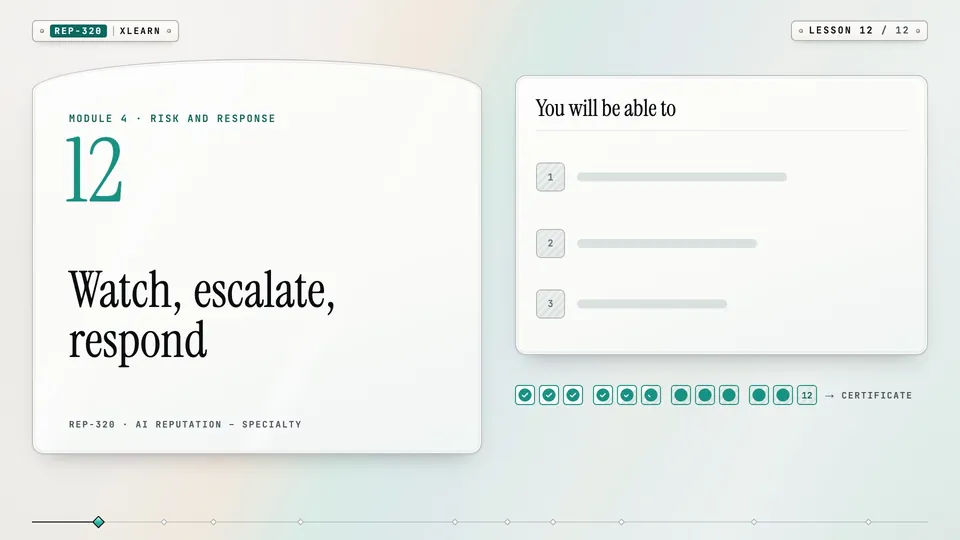
4 modules, 12 lessons, about 34 minutes of video. Each lesson has captions, chapters, a transcript and a practice quiz.
Module 1 · 3 lessons ·
Where assistants get their view of a brand (five source families), how facts and feelings differ and are fixed differently, and how to audit what assistants say with a graded, ranked sheet.
Lesson 1
An AI answer about a brand is a mirror of its footprint. Five source families feed it: your own site, reviews, news, knowledge bases such as encyclopedias, and forums and social posts. When they agree and are current the reflection is sharp; when they clash or go stale it warps. Every claim leaves a trail back to its sources, so trace a claim before you react. Different questions lean on different sources: feelings ("is it quiet?") lean on reviews and forums, facts ("what time is check-in?", "who owns it?") on your site, news and knowledge bases. The source mix tells you where to work. Worked example: two years after Quillmere Harbour’s renovation ended, assistants still warn about building noise, fed by 2023 reviews and a travel-forum thread, while the hotel’s own site never said the work was done.
Lesson 2
Answers mix two kinds of claim. Fact claims can be checked: a check-in time, an owner, a price, a date. Each is right or wrong and traces to one or two sources. Feelings are summed up from many voices, mostly reviews and forums: "tired", "noisy", "welcoming". The two are fixed differently. A wrong fact is corrected at its source. A bad feeling cannot be argued away; it is earned back with better experiences, answered complaints and fresh evidence. The claim ledger records every claim, its type (fact or feeling), its source family and its status, so the team always knows which kind of fix it is working on.
Lesson 3
An audit replaces screenshots with a method. Build a reputation prompt set: the questions buyers and journalists ask about the brand by name ("is Quillmere good?", "Quillmere reviews", "Quillmere or Caskwell?", "who owns Quillmere?", "any problems at Quillmere?"). Ask each prompt in several assistants, more than once, in clean sessions, and date every run. Grade every claim right, stale, wrong or missing. Then rank: severity is reach (how many prompts and assistants carry the claim) times harm (what it costs a buyer or the brand). The audit sheet and the top-five list are what the team fixes first, and the baseline the next audit is compared with.
Module 2 · 3 lessons ·
The correction ladder from your own page to the assistants’ feedback buttons; a dated facts hub that every profile agrees with; one clear entity with a managed knowledge panel and Wikipedia requests made the way its rules allow.
Lesson 4
A wrong claim is fixed where it comes from, so the correction ladder starts at home. First your own page: correct it and date the change. Then the profiles and directories that repeat the fact: business profiles, maps, booking and listing sites. Then the publisher: ask for a dated update note on the original article. Then the thread: reply with the current fact, saying who you are. Only then the assistants’ feedback buttons: the thumbs-down, the flag, the report form. As of October 2026 those are signals, not a correction desk: vendors say they use feedback to improve their systems, and none promises to correct an answer about a business on request. Personal-data removal requests exist for people under privacy law, not for brand facts.
Lesson 5
Assistants are confident when the facts agree everywhere, so give them one place to agree with. The facts hub is a plain-text page on your own site that states every core fact with an as-of date: legal name and brand name, founding year, owner, locations and addresses, hours, prices, policies, and what changed when. Ask your web team to label the page as an Organization (a machine-readable label called structured data) with links to your official profiles, link the hub from every profile, and keep every profile in agreement with it. Facts locked in PDFs, images and press kits are weak copies that drift out of date. Files such as llms.txt and brand.json can point to the hub, but as of October 2026 they are proposals, not standards.
Lesson 6
To an assistant, your brand is an entity: one distinct thing with a stable name and identifiers. A same-name company, a rival next door or an old trading name can blur it, and a blurred entity gets merged facts and the wrong photo. Tell yourself apart with the legal name, the address, the founding year, registration numbers and links to your official profiles, on the hub and on every profile. A knowledge panel is built by the search engine from sources across the web: a verified representative can claim it and suggest changes, which are reviewed against public information (a description taken from another site is changed at that site). Wikipedia and Wikidata follow their own rules: an article needs significant coverage in independent sources (press releases do not count); people with a conflict of interest are strongly discouraged from editing the article and should disclose and request changes on its talk page; anyone paid to edit must disclose it under the Wikimedia Foundation’s terms of use.
Module 3 · 3 lessons ·
Review programs inside the US, UK and EU rules and the platforms’ policies; earned media and named experts; honest, disclosed presence in communities.
Lesson 7
Reviews are the loudest voice in tone, and the most regulated. An honest program asks every customer after the experience (not only the happy ones), makes it easy, replies to every review with the facts and the fix, never ties a reward to what a review says, discloses any reward, never writes or commissions reviews, and never threatens reviewers. The rules, by jurisdiction and date: in the United States the FTC’s rule on consumer reviews and testimonials (in force since 21 October 2024) and its Endorsement Guides (revised July 2023); in the United Kingdom the Digital Markets, Competition and Consumers Act, which since 6 April 2025 bans fake reviews, reviews that hide a reward, and publishing reviews in a misleading way; in the European Union the Unfair Commercial Practices Directive as amended, applied since 28 May 2022 through each member state’s own law, which bans false reviews and misrepresenting reviews. Platforms add their own, often stricter: as of October 2026 Google allows asking but bans rewards and selective asking, and Yelp says businesses should never ask. Rules change: check your local rules and each platform’s policy before you launch. This is not legal advice.
Lesson 8
Assistants lean on independent, named, dated coverage when they decide whether to trust a brand: news, trade press, expert commentary. The brand’s own voice (press releases, site claims, the chief executive’s posts) is useful for facts but weak as proof that others agree; Wikipedia does not count it towards notability at all. Earned media is won with a story a journalist can check: new, specific, timely, with data and a named expert. Keep an experts page on your site with names, roles and credentials, so journalists and crawlers find them. Several independent sources saying the same thing is corroboration, and corroboration is what makes a mirror sharp. Paid coverage must be labelled as paid, and it is not independent.
Lesson 9
Forums, question-and-answer sites and social groups are where feelings and recommendations form, and industry studies in 2025 and 2026 put community sites among the domains AI answers cite most. The rule is to join as yourself. Say who you are and what your interest is in the first line. Read each community’s rules first: many ban or ration self-promotion, and those rules come before your plan. Answer questions, add facts, reply to threads about your brand. Never astroturf: no fake accounts, no staff posing as customers, no paid posts without disclosure. In the United States the FTC’s Endorsement Guides expect paid and employee endorsements to be disclosed; EU and UK consumer law ban a business posing as a consumer and paid promotion that is not made clear. Check your local rules.
Module 4 · 3 lessons ·
Old crises that keep reflecting, fake reviews, invented claims and rivals, and a watch, escalate and respond routine with triggers, owners and time limits.
Lesson 10
A resolved incident keeps reflecting while its coverage is still the freshest, most-linked thing about you, and a correction never fully erases a first impression (researchers call this the continued influence effect). The fix is not deletion. Keep the record and add the resolution: a dated resolution on the facts hub, update notes on the original coverage, fresh and specific coverage of what is true now, and a direct answer in your own voice to the question people ask. Write statements as a truth sandwich: the fact, the myth once, the fact again with evidence. Match the response to the responsibility: deny only what is false; when you were responsible, acknowledge it, show the fix with dates and rebuild.
Lesson 11
Three different problems need three different answers. Fake reviews and endorsements, for you or against you, show patterns: a burst in one night, near-identical wording, brand-new accounts. Document the pattern and report it to the platform with evidence; never answer fakes with fakes, and remember that paying for negative reviews of a rival is banned too. AI errors come in two kinds. A claim that appears in no source is a hallucination (the model guessed): send feedback and make the true fact easy to find. A claim that appears in a source is a source error: fix the source. Rivals are handled with honest comparisons: specific, checkable facts on your own pages, no running the rival down, no posing as someone else. Whether an AI provider answers in law for a false statement in an answer is being tested in the courts (a German court said yes in a first, not yet final, ruling in May 2026); that is a question for a lawyer, and the last rung of the ladder.
Lesson 12
Reputation work becomes a routine. Watch: a monthly mirror check runs the reputation prompt set in several assistants, with repeats, in clean sessions, against last month’s baseline. Set triggers with thresholds: a wrong core fact in two assistants, a drop in tone on a key prompt, a new source in the mix. Escalate by rule, up a ladder with an owner and a time limit on every rung: watch, verify (reproduce it, grade it, find the source), fix the source, send feedback, make a public statement, go to a lawyer. Respond with facts, in the truth-sandwich form. Report monthly: what assistants say now, what changed, what was fixed and what is open, with sources. The course ends where it began, in a hall of mirrors that is finally sharp.
Watch, practice, prove, then get certified: the same four steps in every Xlearn by Sophyx course.
Watch all 12 lessons. Each one is about 2 to 3 minutes, with captions, chapters and a transcript.
Take the practice quiz after each lesson. Try as often as you like, and every wrong answer tells you why.
Pass the final exam: 40 questions, 60 minutes, 75% to pass, and 24 hours between attempts. Then a final project, scored against a written rubric with feedback. You can revise and resubmit.
Your certificate gets its own credential ID and a public page anyone can check. Add it to LinkedIn in one click or download the PDF. It is valid for 12 months.
You can retake it after 24 hours.
Pick a brand: your own, a client's with their permission, or the fictional Quillmere Hotels data pack. Hand in one deliverable for each part below. Each criterion is scored from 0 to 3 against its descriptor, and you pass with a 2 or higher on every one. Two graders score one in ten submissions, to keep scoring fair. You get written feedback and can revise and resubmit.
Prompt set and audit sheet (M1)
A reputation prompt set of 12 or more prompts, run in 3 assistants with repeats in clean sessions, every claim graded right, stale, wrong or missing, with its source.
Claim ledger (M1)
At least 20 claims, each typed fact or feeling, with its source family, its status and the kind of fix.
Priority list (M1)
The top five issues ranked by reach times harm, with the reasoning.
Correction log (M2)
Three claims taken up the ladder: own page, profiles and directories, publisher update request, thread reply, then feedback, each step dated.
Facts hub (M2)
A live plain-text page of 15 or more dated core facts, labelled as an Organization with links to the official profiles, and a 5-profile consistency check.
Entity map and request (M2)
The brand’s entity checked across assistants and search, mix-ups noted with the facts that tell it apart, and one knowledge-panel suggestion or disclosed wiki request made the way the rules allow.
Review program (M3)
A request that asks every customer, reply templates, 5 real replies, and a check against the US, UK, EU and platform rules as of the submission date.
Earned media pitch and experts page (M3)
One checkable pitch (new, specific, timely, with data and a named expert) sent to relevant outlets, and a live experts page with names, roles and credentials.
Community replies (M3)
Three replies in threads about the brand, each stating the author’s role in the first line, with a log of the community rules followed.
Resolution for an old issue (M4)
A dated resolution (what happened, what changed, when, who verified it) in truth-sandwich form, with update-note requests to publishers and a response that fits the responsibility.
Triage log (M4)
Three wrong claims classified as hallucination, source error or fake, with the source search shown and the matching action taken.
Escalation ladder and report (M4)
Triggers with thresholds; a ladder from watch to legal with an owner and a time limit on every rung; the monthly report template.
Honesty and the rules
Fictional brands and illustrative numbers labelled; no fake reviews, undisclosed posts or review gating anywhere in the submission; rules quoted with jurisdiction and date, and no legal advice given.
One page that proves what you learned, with a link anyone can open to check it.

Xlearn by Sophyx
Certificate of completion
This certifies that
Your name
has earned the credential
Sophyx Certified AI Reputation – Specialty
for completing the 12 lessons of AI Reputation Specialty, passing the final exam and passing the final project.
It is a Sophyx credential, not an accredited qualification.
Open a sample certificateMore on how certificates work is on the Xlearn by Sophyx page.
Every course sits on one ladder, from fundamentals to expert. See the courses coming next.
Flagship · AE-200
Earns: Certified Answer Engineer
How AI answers are made, and how to get a brand named in them. The core course, and the place to start.
Regular price USD 89, free for a limited time.
Associate · AEO-210
Earns: Sophyx Certified AEO Content Specialist – Associate
For content teams: plan, write, prove, refresh and measure pages that AI assistants quote and send buyers to.
Regular price USD 99, free for a limited time.
Professional · GEO-300
Earns: Sophyx Certified Technical GEO Engineer – Professional
For developers and technical SEOs: build a site AI can fetch, read and act on, and keep it that way.
Regular price USD 129, free for a limited time.
Professional · GEO-310
Earns: Sophyx Certified GEO Analytics Professional
For analytics and growth teams: measure AI visibility from crawler reads to conversions, with numbers you can defend.
Regular price USD 149, free for a limited time.
Twelve short lessons. Regular price USD 89, free for a limited time. Finish with a certificate anyone can check.